


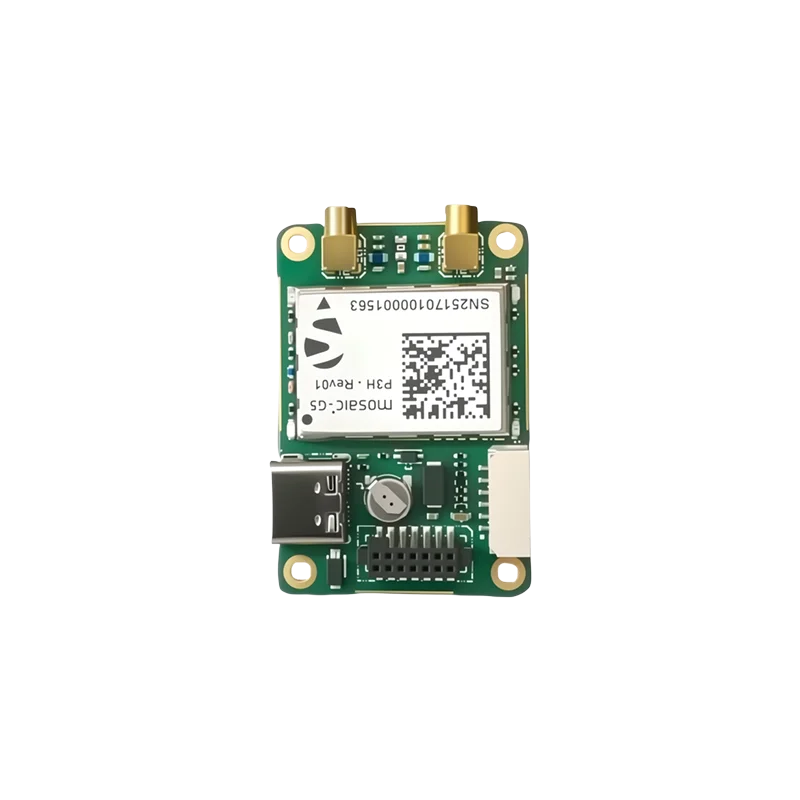
Initialization time is the single specification of a RTK GNSS module that quietly determines whether a survey, a UAV flight, or a machine-control shift makes money or loses money. The first fix in 5 seconds versus the first fix in 60 seconds is the difference between a productive hour and a frustrating one, and the cumulative effect across a crew or a fleet is the difference between a profitable program and one that is fighting its own equipment. This guide walks through what RTK initialization actually means, what makes it slow, and the design choices that determine whether an RTK GNSS module initializes in seconds or in tens of seconds.
If you are a survey crew lead, a UAV integrator, or a machine-control system architect trying to maximize field productivity from a fleet of RTK GNSS modules, the goal of this article is to give you a working framework for reading the initialization time specification, validating it in the field, and matching it to the operational tempo of your program. We will not push a single chipset, because no single RTK GNSS module fits every application. What we will do is walk through the criteria that actually matter when the crew is on the clock.
What RTK Initialization Actually Does in a GNSS Module
RTK initialization is the process of resolving the integer ambiguities of the carrier phase measurements from the satellites in view. The receiver knows the fractional phase of each carrier, but it has to figure out the integer number of cycles between the satellite and the antenna. Resolving those integers is what turns a floating-point solution with meter-level accuracy into a fixed solution with centimeter-level accuracy.
In practice, the RTK GNSS module uses a search over the integer space, narrowed by the geometry of the satellites, the quality of the correction stream, and the observation window. A modern RTK GNSS module with a wide-lane / narrow-lane combination and a multi-frequency front-end can resolve the integers in 5 to 10 seconds in good conditions. A consumer RTK GNSS module with single-frequency input may need 30 to 60 seconds for the same convergence.
Why Initialization Time Drives Field Productivity
Initialization time in an RTK GNSS module is not just a datasheet number. It is the single biggest determinant of how much useful work a crew or a fleet can do in a day. Three operational effects dominate.
Time-to-first-fix per occupation. A survey crew that has to occupy 50 control points in a day loses 5 minutes per point to initialization if the RTK GNSS module is slow. That is 4 hours of dead time across the day, which is a full crew shift lost to waiting for the receiver. A 5-second initialization versus a 60-second initialization is the difference between a profitable day and a marginal one.
Re-initialization after a signal loss. A UAV that flies under a bridge, a machine that drives through a tunnel, or a survey crew that walks next to a building will lose RTK lock. The RTK GNSS module has to re-initialize after the loss, and a slow module will be unavailable for tens of seconds. A 5-second re-initialization is barely noticeable; a 60-second re-initialization is a workflow killer.
Battery and operational endurance. An RTK GNSS module that is searching for the integer solution draws more power than a module that has already converged. A slow module will drain the battery 20 to 40 percent faster than a fast one, which limits the operational endurance of a UAV flight or a battery-powered rover.
Key Specifications That Drive RTK Initialization
An RTK GNSS module's initialization time is driven by a small set of specifications. Reading a generic GNSS module datasheet without a framework is a recipe for buying the wrong part.
1. Constellation and frequency support. An RTK GNSS module that supports L1, L2, and L5 from at least GPS, BeiDou, Galileo, and GLONASS will initialize faster than a single-frequency module. The extra frequencies and constellations provide more measurements for the ambiguity search, which reduces the time to a fixed solution. A modern RTK GNSS module should support at least 4 constellations and 3 frequencies.
2. Channel count and tracking sensitivity. A modern RTK GNSS module should have at least 140 channels to track all the visible satellites across all the supported constellations and frequencies. Sensitivity below -165 dBm is the practical floor for tree canopy and urban canyon; parts with -160 dBm sensitivity will struggle in those environments and the initialization time will balloon.
3. Correction source quality. An RTK GNSS module can only initialize as fast as the correction stream allows. A local base station at 1 km with a clean radio link is the fastest. A network RTK service over a stable cellular connection is the next fastest. A correction source with high latency, low update rate, or noisy data will slow down the initialization by 2 to 5 times.
4. Observation window length. A static RTK GNSS module that observes the satellites for 30 seconds before moving can use the longer observation to fix the ambiguities faster. A kinematic RTK GNSS module that is constantly moving has to fix from a shorter observation, which is harder and slower. Always check the initialization time on a moving platform, not a static one, for any application that involves motion.
5. Multipath environment. An RTK GNSS module in an open-sky environment initializes in seconds. The same module under tree canopy or in urban canyon may need 30 to 60 seconds for the same convergence. Always check the initialization time in the actual deployment environment, not on the bench in the parking lot.
How Initialization Time Varies Across Applications
An RTK GNSS module's initialization time matters differently across the application classes that use it. The right initialization time depends on the operational tempo of the program.
Surveying. A survey crew that occupies 50 to 100 points in a day needs an RTK GNSS module that initializes in 5 to 10 seconds. Anything slower loses meaningful time across the day, and a slow module can turn a profitable job into a marginal one. Survey crews often carry a backup receiver as a hedge, but the backup is rarely used; the slow module is the daily reality.
UAV mapping. A UAV that has to initialize before takeoff needs an RTK GNSS module that initializes in 5 to 15 seconds, otherwise the pre-flight delay eats into the flight window. A UAV that initializes in flight, after takeoff, can tolerate a longer initialization time, but the flight time is limited by battery, and every second of initialization is a second of flight time lost.
Machine control. A bulldozer, a grader, or a paving machine that has to re-initialize after a signal loss needs an RTK GNSS module that re-converges in 5 to 15 seconds. Anything slower brings the machine to a halt, which is a significant cost on a production earthworks site. The right RTK GNSS module for machine control is one that holds fix through the loss, or that re-converges immediately after.
Precision agriculture. A tractor or a harvester that has to re-initialize at the end of every row needs an RTK GNSS module that initializes in 5 to 10 seconds. Anything slower forces the operator to wait at the row end, which costs time and fuel across a long day in the field.
Common Pitfalls in RTK GNSS Module Initialization
Across our RTK GNSS module deployments, the same four mistakes show up more often than the others. Skim them before you commit to a part.
Trusting the open-sky initialization time. An RTK GNSS module that initializes in 5 seconds in open sky may need 60 seconds under tree canopy or in urban canyon. Always test the initialization time in the actual deployment environment, not on the bench.
Using a poor correction source. An RTK GNSS module can only initialize as fast as the correction stream allows. A noisy or delayed correction source will slow the initialization by 2 to 5 times, regardless of the receiver. Always check the correction source quality before blaming the receiver.
Mounting the antenna on a vibrating structure. An RTK GNSS module mounted on a vibrating tractor or a swaying UAV will see the antenna phase center move, which complicates the ambiguity resolution. Use a vibration-isolated mount, or accept a longer initialization time.
Treating single-frequency as sufficient. A single-frequency RTK GNSS module can initialize in 30 to 60 seconds in good conditions and may not initialize at all under canopy. For any application that has to be re-initialized frequently, multi-frequency is the right answer and the BOM premium pays back in operational tempo.
Where We Fit: xyzgnss RTK GNSS Module Portfolio
At xyzgnss we have built our RTK GNSS module portfolio around the same principle that drives the rest of our GNSS product line: tight initialization specifications, documented behavior, and reference designs that move from the bench to a deployed system without a re-engineering step. Our RTK GNSS module family includes compact OEM modules for UAV and handheld applications, mid-range modules for survey and machine control, and high-precision modules for reference station and geodetic applications.
You can browse the RTK GNSS module family on the product page, and read our engineering notes on RTK GNSS module guide for a wider view of the trade-offs. For a hands-on reference, the RTK GNSS module for deformation monitoring field guide covers the long-baseline application, and our RTK GNSS module ZED-F9P is a representative multi-frequency part for high-precision applications.
If you are evaluating an RTK GNSS module for a new program, our technical team can ship an evaluation kit with the module, a matched antenna, a reference base station, and an NTRIP client configuration so you can validate the initialization time in your real environment. We have supported surveying, UAV, machine control, and precision agriculture customers across multiple regions, and we are happy to bring that field experience to your project.
Conclusion
Initialization time is the single most important productivity specification for any RTK GNSS module used in surveying, UAV, machine control, or precision agriculture. An RTK GNSS module that initializes in seconds, holds fix through minor obstructions, and re-converges quickly after a signal loss is the foundation of a productive field program. If you are weighing an RTK GNSS module for a new program, our engineering team can help you compare the candidates in your real environment before you commit to a part.
Need an RTK GNSS module with fast initialization? Talk to our engineering team about a side-by-side evaluation, a reference design, and a sample kit. Contact xyzgnss to start a project →
Frequently Asked Questions
Q1: What Is RTK Initialization Time and Why Does It Matter for a GNSS Module?
RTK initialization time is the time it takes a GNSS module to resolve the integer ambiguities of the carrier phase measurements and produce a centimeter-level fixed solution. A serious RTK GNSS module initializes in 5 to 10 seconds in good conditions. The initialization time matters because every second of waiting is a second of lost productivity for a survey crew, a UAV, a machine, or a tractor.
Q2: What Factors Slow Down RTK Initialization in a GNSS Module?
RTK initialization in a GNSS module is slowed by a small set of factors: fewer satellites in view, fewer frequencies tracked, a poor correction stream, multipath, and vibration. A multi-frequency RTK GNSS module with 140 or more channels and a clean correction source will initialize in seconds. A single-frequency module with a noisy correction source may need 30 to 60 seconds for the same convergence.
Q3: Does a Multi-Frequency RTK GNSS Module Initialize Faster Than a Single-Frequency Module?
A multi-frequency RTK GNSS module initializes faster than a single-frequency module because the extra frequencies provide more measurements for the ambiguity search. In open sky, a multi-frequency module can initialize in 5 to 10 seconds, while a single-frequency module needs 30 to 60 seconds. Under tree canopy or in urban canyon, the gap widens, and a single-frequency module may not initialize at all.
Q4: How Long Does Re-Initialization Take After a Signal Loss?
Re-initialization time after a signal loss depends on the RTK GNSS module, the satellite geometry at the time of re-acquisition, and the quality of the correction stream. A serious RTK GNSS module re-converges in 5 to 15 seconds in good conditions. A consumer module may need 30 to 60 seconds. For applications that experience frequent signal losses, choose an RTK GNSS module with documented fast re-initialization.
Q5: Where Can I Get an RTK GNSS Module With Documented Initialization Time?
We supply RTK GNSS modules with documented initialization time in open sky, under canopy, and after a signal loss. Each module ships with a test report covering the convergence time across multiple sky conditions. Contact our engineering team and we can share the test report for the RTK GNSS module you are evaluating, along with a sample module and a reference design for your application.