

We Have The Best Solutions for Your Business
Precision Navigation Solutions for a Connected World
As a leading solution supplier integrating R&D, manufacturing, and sales, we offer a wide range of products including GNSS satellite antennas, positioning terminals, data communication products, and customized high-precision Beidou solutions. Our expertise spans measurement & monitoring, aerospace, communication time service, autonomous driving, mechanical control, intelligent transportation, driving tests, and training.
I’ve been in the high-precision positioning and communications industry for over a decade, and I vividly remember the "old days" of vehicle telematics installations. To get a vehicle fully connected, an installer would have to mount a GPS puck, a cellular whip antenna, and maybe a separate stubby antenna for Wi-Fi. It meant drilling three holes in a vehicle's roof, running three sets of cables, and hoping they didn't interfere with each other. It was slow, expensive, and messy. Today, that chaos is a relic of the past, thanks to the elegant engineering of the modern combo antenna.
This evolution was driven by necessity. A simple GPS tracker evolved into a complex mobile gateway, demanding constant, high-speed data transfer. The need for a single, integrated solution became obvious, but the engineering challenge was immense. The real secret to a high-performance combo antenna isn't just fitting everything into one housing; it's achieving high isolation. You have a powerful cellular transmitter shouting just millimeters away from an incredibly sensitive GNSS receiver that's trying to hear the faint whispers of a satellite 20,000 km away. Without meticulous design, the cellular signal will blind the GNSS receiver. This is where professional-grade engineering, like we do, makes all the difference.
A quality combo antenna is a marvel of RF engineering, with carefully designed internal structures that shield and separate the different antenna elements. This ensures the high-gain cellular part delivers maximum data throughput, while the GNSS part maintains a low noise figure and a clear view of the sky. The result is a single, rugged, easy-to-install unit that outperforms the messy collection of antennas it replaces. It saves our clients direct costs in installation labor and long-term costs by providing fewer points of failure.
For any fleet manager or system integrator, the move to an integrated solution is one of the clearest ROIs in the industry. It represents the shift from a cobbled-together solution to a purpose-built, professional one. In my view, the combo antenna is more than just a convenience; it's the critical enabler of the reliable, always-on connectivity that powers the entire modern mobile ecosystem.
Featured Products
Collection about xyzgnss

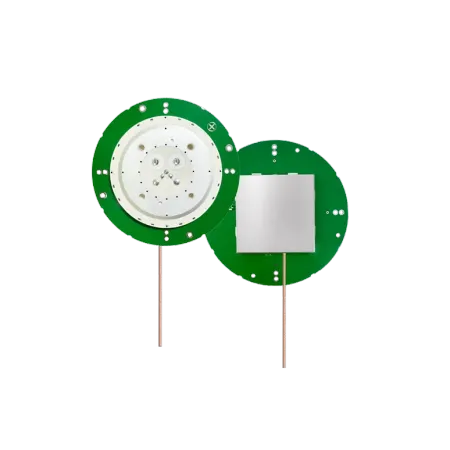
RTK GNSS Antenna
RTK GNSS Antenna
Frequently Asked Question
Do you have any question?
A combo antenna, also known as a combination or multi-band antenna, is a single antenna unit that houses multiple, separate antenna elements for different wireless services. For example, a popular configuration combines a GNSS antenna (for GPS, Beidou, etc.) with a 4G/LTE/5G cellular antenna and a Wi-Fi/Bluetooth antenna, all in one physical enclosure with separate cable feeds for each service.
The primary benefits are simplification and efficiency. Instead of drilling multiple holes and running multiple cables for different antennas, you only need one mounting point and one cable bundle. This drastically reduces installation time and labor costs, lowers the potential for leaks in vehicle roofs, and creates a much cleaner, more professional aesthetic.
This is a critical concern, and where quality engineering matters. A well-designed combo antenna uses sophisticated techniques to ensure high isolation between the different antenna elements. This prevents the high-power transmitter of the cellular modem from "deafening" the highly sensitive GNSS receiver, ensuring all services operate at peak performance without interfering with one another.
The combo antenna is ideal for any application requiring multiple wireless technologies in a compact space. Key markets include vehicle telematics, fleet management, public transportation (buses, trains), emergency services vehicles (police, fire, ambulance), and remote IoT/M2M monitoring stations.
Various configurations are available to meet specific needs. Common options for a combo antenna include 2-in-1 (e.g., GNSS + 4G LTE), 3-in-1 (e.g., GNSS + 4G LTE + Wi-Fi), and even more complex 5-in-1 or 7-in-1 arrangements that incorporate multiple cellular antennas (MIMO) for higher data speeds.
No, in fact, it's significantly easier than installing multiple individual antennas. A typical stud-mount combo antenna requires drilling just one hole. Once the antenna is secured and sealed, the installer simply routes the pre-bundled set of cables to the corresponding modems and receivers inside the vehicle or enclosure, saving significant time and effort.