

We Have The Best Solutions for Your Business
Precision Navigation Solutions for a Connected World
As a leading solution supplier integrating R&D, manufacturing, and sales, we offer a wide range of products including GNSS satellite antennas, positioning terminals, data communication products, and customized high-precision Beidou solutions. Our expertise spans measurement & monitoring, aerospace, communication time service, autonomous driving, mechanical control, intelligent transportation, driving tests, and training.
After more than a decade engineering high-precision positioning solutions, I’ve seen the term "GPS" become a commodity. But I can tell you with absolute certainty that there is nothing "commodity" about a true RTK GNSS module. This component is to a standard GPS chip what a Formula 1 engine is to a lawnmower engine. They both use the same basic principles, but they exist in entirely different universes of performance and complexity. It is, without exaggeration, the engine of precision for the entire modern autonomous world.
The real magic of a professional-grade RTK GNSS module isn't just in the silicon; it's in the incredibly sophisticated firmware and algorithms that live on it. This is the "brain" that performs the near-miraculous task of carrier phase integer ambiguity resolution in seconds. It's constantly analyzing the faint, complex signals from multiple satellite constellations on multiple frequency bands, comparing them against a stream of correction data, and solving a complex mathematical puzzle to deliver a position you can build a skyscraper on. A lesser module will struggle with this, staying "stuck in float" or losing its fix in the face of the slightest multipath interference.
This is why, for any serious OEM or system integrator, the selection of this component is the most critical decision they will make. The entire performance of their multi-hundred-thousand-dollar survey drone or autonomous tractor rests on the reliability of this one small board. A superior RTK GNSS module translates directly to less time wasted in the field waiting for a fix, cleaner data for mapping, and smoother, more reliable control for an autonomous vehicle. It is the very source of data integrity for the entire system.
So when you are designing your next product that requires absolute certainty of its location, look beyond the simple specs. Understand that you are choosing the heart of your system. You are choosing the engine that will either reliably deliver ground truth, or leave you adrift in a sea of ambiguity. The difference is profound, and it all comes down to the quality and sophistication of the RTK GNSS module.
Featured Products
Collection about xyzgnss
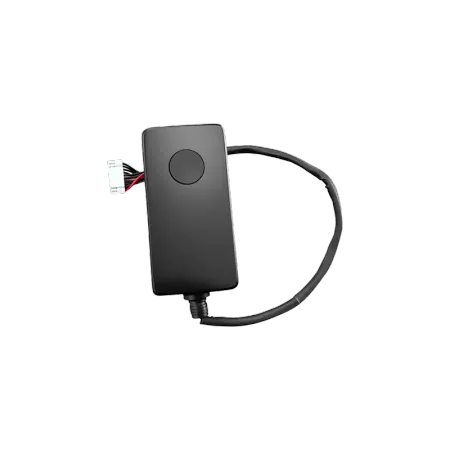
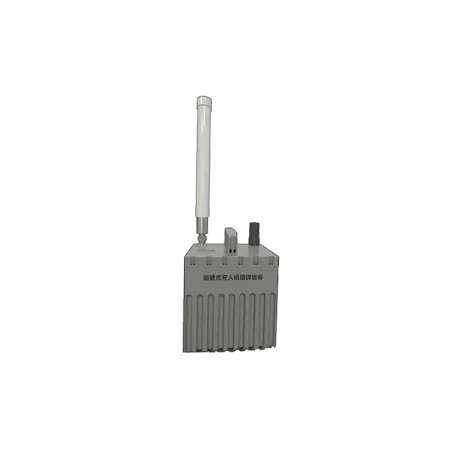
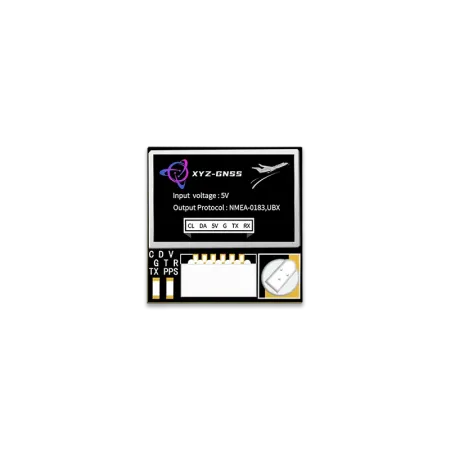
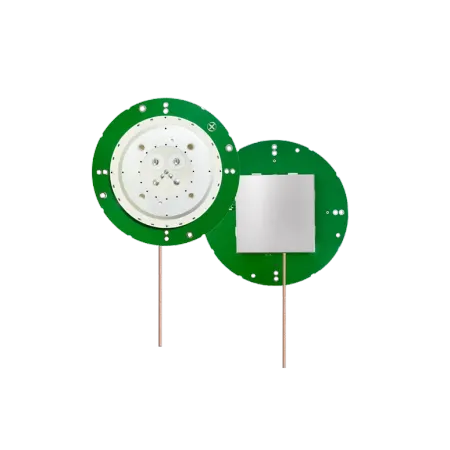
RTK GNSS Antenna
RTK GNSS Antenna
Frequently Asked Question
Do you have any question?
The main function of an RTK GNSS module is to calculate a device's position with centimeter-level accuracy in real-time. It achieves this by processing its own satellite observations along with correction data received from a nearby, stationary base station. This differential technique allows it to resolve carrier phase ambiguities and cancel out most atmospheric and satellite clock errors.
A standard GPS module can only achieve meter-level accuracy. An RTK GNSS module is far more advanced; it is typically "multi-band" (receiving L1, L2, L5 signals) and contains a powerful processing engine with specialized firmware designed to handle RTK calculations. It must be able to receive and apply correction data (in RTCM format) to achieve its high precision.
A multi-band RTK GNSS module can receive and process signals on multiple frequencies (e.g., L1 and L5) from the same satellites. This is the single most important feature for modern RTK, as it allows the module's algorithms to model and remove the ionospheric delay—the largest source of GNSS error. This results in dramatically faster initialization ("fix") times and more reliable performance.
A "float" solution is an intermediate state where the RTK GNSS module has started processing corrections but has not yet resolved the integer ambiguities, providing decimeter-level accuracy (e.g., 10-30 cm). A "fixed" solution is the goal: the module has solved the ambiguities and is operating at its maximum, centimeter-level accuracy. The quality of the module and its antenna determines how quickly it can achieve a "fix."
Yes, a complete RTK system requires a pair of receivers. You need one RTK GNSS module configured as a stationary "base station" to generate corrections, and another identical or compatible module in your moving device (the "rover") to receive those corrections and calculate the precise position. Alternatively, a single rover can be used if it has a connection to a public CORS/NTRIP correction service.
An RTK GNSS module typically communicates with a host processor (like a microcontroller or computer) via a standard UART serial interface. It outputs its high-precision position data using the NMEA protocol and receives the incoming RTK correction data (RTCM format) through the same interface, which the host system must relay to it from a radio or internet link.