

We Have The Best Solutions for Your Business
Precision Navigation Solutions for a Connected World
As a leading solution supplier integrating R&D, manufacturing, and sales, we offer a wide range of products including GNSS satellite antennas, positioning terminals, data communication products, and customized high-precision Beidou solutions. Our expertise spans measurement & monitoring, aerospace, communication time service, autonomous driving, mechanical control, intelligent transportation, driving tests, and training.
In my career in high-precision GNSS, which now spans more than a decade, I've seen a constant battle between performance and practicality. Nowhere is this battle more intense than in the world of UAVs. You can have the most advanced RTK receiver on the market, but if the antenna is too heavy, it ruins your flight time. If it's too susceptible to multipath, your expensive survey data is worthless. For years, this was a frustrating trade-off. Then, the modern GNSS helical antenna came of age, and for professionals, it changed everything.
The true genius of the helical antenna lies in its mastery of circular polarization. Imagine the GNSS signal is a perfectly thrown football, spiraling through the air. A helical antenna is like a receiver's hands, perfectly shaped to catch that spiral. Now, imagine that football bounces off a wall (a building, the ground). The spiral is disrupted, often reversed. The antenna is so well-designed that it simply "drops" these bounced, corrupted signals. This physical property of rejecting multipath is what makes the data from a helical antenna so incredibly clean and reliable, even when flying in complex environments.
But it's more than just multipath rejection. The design of a quadrifilar helical antenna gives it a beautifully wide, uniform view of the sky—what we call a broad beamwidth. For a drone that is constantly banking and changing orientation, this is critical. A lesser antenna might lose lock on satellites near the horizon during a turn, but the helical keeps its eye on the whole sky, from zenith to horizon. This means it tracks more satellites, more of the time, leading to a more robust and continuously available position fix, which is the bedrock of safe and reliable autonomous flight.
When you combine this top-tier electronic performance with its incredibly low weight and compact size, you understand why I call it the unsung hero. It is the elegant solution that finally solved the UAV's weight-versus-performance paradox. For any serious commercial drone application, from surveying to infrastructure inspection, the helical antenna is not just a component; it is the fundamental enabler of precision, reliability, and efficiency.
Featured Products
Collection about xyzgnss
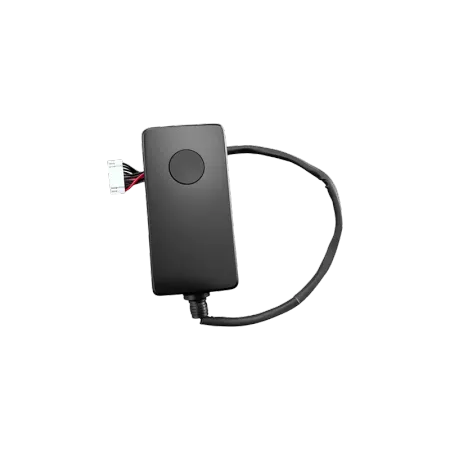
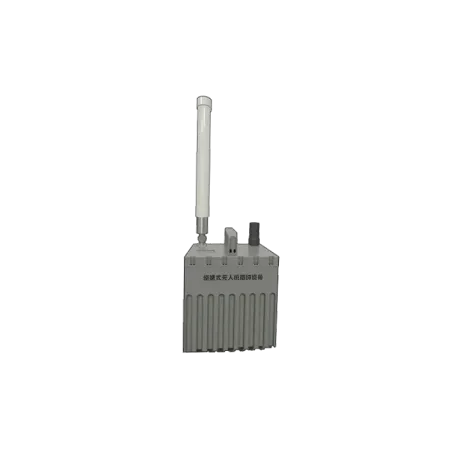
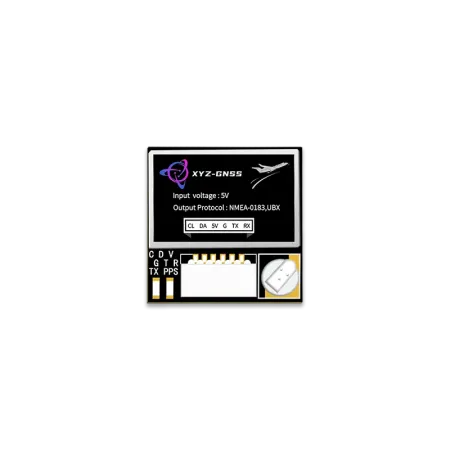
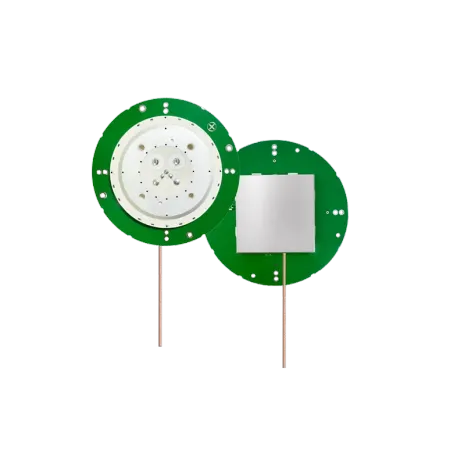
RTK GNSS Antenna
RTK GNSS Antenna
Frequently Asked Question
Do you have any question?
The defining feature of a helical antenna is its excellent circular polarization. GNSS signals are transmitted with right-hand circular polarization (RHCP). This antenna is perfectly tuned to receive these signals while rejecting reflected, multipath signals, which often have their polarization reversed. This results in a much cleaner signal and more accurate position calculation.
A helical antenna offers the perfect combination of high performance and low Size, Weight, and Power (SWaP). It provides the multipath rejection and stable phase center of a much larger antenna in a fraction of the size and weight, which is absolutely critical for maximizing a drone's flight time and payload capacity.
A quadrifilar helical antenna (QHA) is a very common and effective type of helical design used for GNSS. It uses four separate helices wound together. This configuration produces a very symmetrical radiation pattern and an excellent axial ratio, meaning it has a highly pure circular polarization, which is ideal for "seeing" the entire sky from horizon to zenith and rejecting interference.
While both can receive GNSS signals, a high-quality helical antenna is technically superior. It has a better axial ratio and a wider beamwidth, meaning it maintains a strong, clean signal lock on more satellites, especially those at low elevation angles. It is also far better at rejecting multipath, making it the preferred choice for high-precision applications in complex environments.
Axial ratio is a measure of how purely circular an antenna's polarization is. A perfect axial ratio is 1 (or 0 dB). The lower the number, the better the antenna is at rejecting cross-polarized signals, which is the primary mechanism for mitigating multipath. A good helical antenna will have an excellent axial ratio, which is a key reason for its superior performance.
Absolutely. In fact, a helical antenna is an ideal choice for lightweight RTK rovers, especially on drones. Its stable phase center and outstanding multipath rejection provide the clean, high-quality signal observations that an RTK receiver needs to achieve a fast and reliable centimeter-level "fix."