

We Have The Best Solutions for Your Business
Precision Navigation Solutions for a Connected World
As a leading solution supplier integrating R&D, manufacturing, and sales, we offer a wide range of products including GNSS satellite antennas, positioning terminals, data communication products, and customized high-precision Beidou solutions. Our expertise spans measurement & monitoring, aerospace, communication time service, autonomous driving, mechanical control, intelligent transportation, driving tests, and training.
Throughout my decade-plus career engineering and deploying high-precision GNSS systems, I’ve had a front-row seat to a silent arms race. On one side, we have incredible advancements in positioning accuracy. On the other, we have the rapidly proliferating threat of signal interference. For years, many in the commercial sector dismissed jamming as a military problem. I’m here to tell you that this mindset is now dangerously outdated. The modern operational environment is an electromagnetically hostile space, and without robust anti-jamming devices, your critical systems are flying blind.
The fundamental weakness of GNSS is the faintness of its signal. A simple, illegal jammer purchased online for less than a hundred dollars can create a zone of signal denial that cripples a multi-million dollar autonomous fleet. A standard GNSS antenna and receiver have no defense; they are overwhelmed by the brute force of the interfering signal. This isn't a hypothetical risk; it's a reality that grounds drone fleets, stops automated port machinery, and corrupts vital timing data every day. The only viable defense is to deploy specialized anti-jamming devices designed specifically for this fight.
At the heart of any effective anti-jamming strategy is a Controlled Reception Pattern Antenna, or CRPA. Think of these anti-jamming devices not as passive receivers, but as intelligent gatekeepers. A CRPA uses an array of antenna elements to constantly scan the sky, listening for both the faint whispers of satellites and the loud shouts of jammers. Through sophisticated digital signal processing, it creates deep "nulls"—cones of silence—aimed directly at the interference sources. This allows it to preserve a clean signal path to the real satellites, enabling the receiver to operate as if the jammer wasn't even there.
This isn't just about protecting a signal; it's about underwriting your entire business model. When your service guarantee, your safety case, or your operational efficiency is built on a foundation of PNT data, that foundation must be unbreakable. Investing in anti-jamming devices is a direct investment in operational resilience and risk mitigation. From my vantage point, the question has shifted from "Can we afford them?" to "Can we possibly afford to operate without them?" In this new reality, a protected signal is the true signal for survival.
Featured Products
Collection about xyzgnss
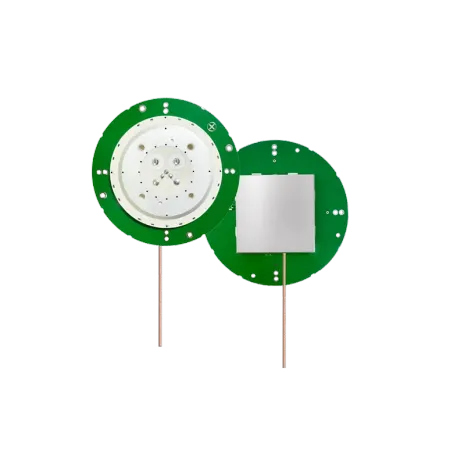
RTK GNSS Antenna
RTK GNSS Antenna
Frequently Asked Question
Do you have any question?
Anti-jamming devices are a category of specialized electronic hardware designed to protect a GNSS receiver from the effects of signal interference. They work by identifying and suppressing unwanted radio frequency signals (jammers) while allowing legitimate satellite signals to pass through. The most critical of these is the antenna, often a CRPA (Controlled Reception Pattern Antenna), which can spatially nullify threats.
The core technology within advanced anti-jamming devices like CRPA antennas uses a multi-element array. This allows the system to determine the direction of arrival for all incoming RF signals. Since the location of GNSS satellites in the sky is known, the device can process and prioritize these signals while actively rejecting powerful, ground-based signals that do not come from a valid direction.
Any operation where a loss of GNSS positioning would result in significant safety risks, financial loss, or mission failure needs anti-jamming devices. This includes autonomous vehicles (cars, trucks, drones), critical infrastructure (power grids, cell towers), precision agriculture, aerospace applications, and high-value asset tracking in logistics and mining.
Modern anti-jamming devices, particularly integrated antennas, are designed for straightforward implementation. Many are built with standard form factors and connectors, allowing them to serve as a direct, "drop-in" replacement for less secure, non-protected antennas. This simplifies the process of upgrading a platform's resilience without requiring a major system redesign.
While their primary function is to combat jamming (signal denial), the sophisticated nature of high-end anti-jamming devices provides a strong foundational defense against spoofing (the transmission of false signals). By analyzing the direction of arrival and other signal characteristics, these systems can help a receiver identify and reject counterfeit satellite signals that are a hallmark of a spoofing attack.
A simple RF filter can only block signals outside of the designated GNSS frequency band. It is powerless against an "in-band" jammer that transmits directly on the same frequency as the satellites. True anti-jamming devices use advanced techniques like spatial processing (beamforming and nulling) to defeat these in-band threats, offering a much higher and more intelligent level of protection.