

We Have The Best Solutions for Your Business
Precision Navigation Solutions for a Connected World
As a leading solution supplier integrating R&D, manufacturing, and sales, we offer a wide range of products including GNSS satellite antennas, positioning terminals, data communication products, and customized high-precision Beidou solutions. Our expertise spans measurement & monitoring, aerospace, communication time service, autonomous driving, mechanical control, intelligent transportation, driving tests, and training.
In my career, spanning over a decade in high-precision GNSS solutions, I’ve seen technology evolve at a breathtaking pace. We’ve moved from simple positioning to centimeter-level accuracy that powers entire industries. But I’ve also seen a dangerous assumption take hold: that a GNSS signal, like the air we breathe, will always be there. In today's congested and contested RF environment, that assumption is a critical liability. The silent threat of signal jamming—once a concern for the battlefield—is now a clear and present danger to commercial operations, and the only professional-grade countermeasure is a purpose-built anti-jamming antenna.
The problem lies in the physics of the signal itself. By the time a GNSS signal travels over 20,000 km from a satellite, it's incredibly faint, weaker than ambient radio noise.A simple, inexpensive jammer can easily overpower it, creating a denial-of-service bubble that can stretch for blocks.For a precision agriculture drone, this means a lost crop survey. For an autonomous haulage truck, it means a complete operational shutdown. For a critical timing server, it means a loss of synchronization that can corrupt financial transactions. A standard antenna is defenseless against this; it simply cannot distinguish the valid signal from the noise. This is the challenge where a sophisticated anti-jamming antenna proves its immense value.
Unlike its passive counterparts, a modern anti-jamming antenna, particularly a Controlled Reception Pattern Antenna (CRPA), doesn't just listen—it actively defends its airspace.Using an array of elements and intelligent signal processing, it performs digital beamforming.Think of it as having exceptional hearing. It knows the direction of the legitimate satellite signals and can dynamically create deep "nulls"—areas of deafness—in the precise direction of any jamming source.This spatial filtering allows the antenna to maintain a robust lock on satellites even when under direct electronic attack, ensuring the PNT data flowing to your receiver is uninterrupted and, most importantly, trustworthy.
Ultimately, investing in this technology is not an equipment upgrade; it's a strategic decision about operational resilience. It's about risk mitigation for high-value autonomous assets and ensuring the integrity of data that drives your business. In an era where positioning data is as valuable as the assets it guides, relying on an unprotected signal is a gamble no serious enterprise can afford to take. With my experience, I can tell you unequivocally: the conversation is no longer about whether you need a GNSS solution, but about how you protect it. And that protection starts with a robust anti-jamming antenna.
Featured Products
Collection about xyzgnss
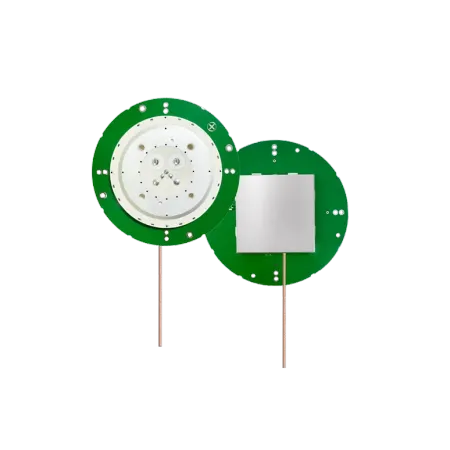
RTK GNSS Antenna
RTK GNSS Antenna
Frequently Asked Question
Do you have any question?
An anti-jamming antenna is a specialized antenna system designed to protect a GNSS receiver from intentional jamming and unintentional interference.It uses advanced techniques like creating "nulls"—or blind spots—in the direction of interfering signals, effectively ignoring the noise while maintaining a clear lock on satellite signals.This ensures the receiver can calculate a precise position even in a contested electromagnetic environment.
A standard GNSS antenna is typically omnidirectional, meaning it listens for signals from all directions, making it vulnerable to powerful, ground-based jammers.A Controlled Reception Pattern Antenna (CRPA), the most common type of anti-jamming antenna, uses an array of multiple antenna elements.This array allows it to use sophisticated signal processing to dynamically shape its reception pattern, focusing on legitimate satellite signals and rejecting interference.
Jamming sources can be both intentional and unintentional. Intentional jammers are devices, often called "privacy jammers," designed to overpower weak GNSS signals.Unintentional interference can come from many sources, including poorly shielded electronics, mobile communication towers, and other radio frequency (RF) transmissions that "bleed" into GNSS frequency bands.A quality anti-jamming antenna is designed to mitigate both types of threats.
While originally developed for military use, the need for an anti-jamming antenna is now critical in many commercial sectors.This includes autonomous vehicles (robotaxis, trucks), where navigation integrity is vital for safety, precision agriculture for uninterrupted field operations, aerospace and UAVs for mission success, and critical infrastructure like communication time services that rely on synchronized timing.
While primarily designed for jamming, the sophisticated nature of an anti-jamming antenna, especially a CRPA, provides a foundational layer of defense against spoofing.Spoofing involves sending false satellite signals to trick a receiver.By differentiating signals based on their direction of arrival, the antenna can help identify and reject counterfeit signals that don't originate from the known positions of GNSS satellites in the sky.
Modern designs focus on seamless integration. Many anti-jamming antenna solutions are engineered to be SWaP (size, weight, and power)-optimized, making them suitable for platforms like UAVs and ground vehicles.They are often designed as a direct replacement for existing non-protected antennas and are compatible with a wide range of existing GNSS receivers, minimizing the engineering effort required to upgrade a system's resilience.