


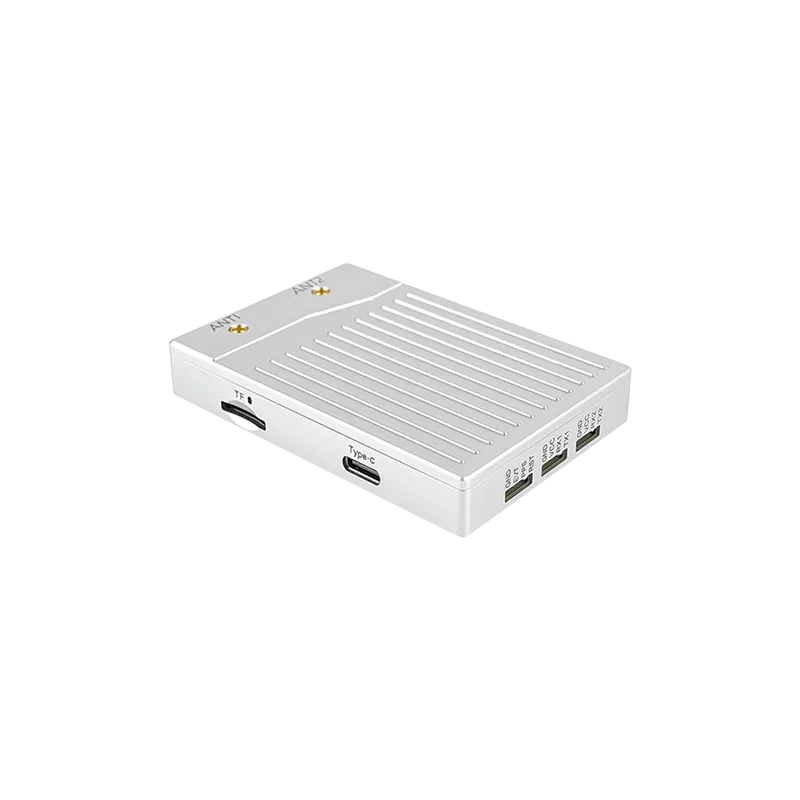
Comprehensive guide on implementing Real-Time Kinematic technology for next-generation robotic systems.
Introduction to High-Precision Robotics
The landscape of modern automation is undergoing a radical shift, driven by the demand for sub-decimeter accuracy in navigation. At the heart of this revolution is the RTK GNSS receiver for robotics, a specialized hardware solution that transcends the limitations of traditional global positioning systems. Standard GNSS solutions often provide accuracy within a few meters, which is sufficient for smartphones or general vehicle navigation. However, for an autonomous lawnmower, a delivery robot, or a precision agriculture tractor, a margin of error of even half a meter can lead to catastrophic failure or significant operational inefficiency.
By utilizing Real-Time Kinematic (RTK) technology, roboticists can achieve centimeter-level localization. This precision is not merely a luxury; it is the fundamental requirement for robots that must interact with complex environments, follow predefined paths with surgical accuracy, and maintain safety protocols in human-populated areas. In this guide, we explore the intricate mechanics, implementation strategies, and professional-grade solutions that make high-precision positioning possible for any robotic platform.
The Mechanics of RTK GNSS Technology
Real-Time Kinematic technology works by analyzing the phase of the satellite signal's carrier wave, rather than just the information content of the signal. To achieve this, an RTK GNSS receiver for robotics requires two primary components: a base station and a rover. The base station is placed at a known, surveyed location. It monitors the satellite signals and calculates the errors caused by atmospheric delays and orbital variations. These corrections are then transmitted in real-time to the "rover" module mounted on the robot.
The rover combines its own satellite observations with the data from the base station to resolve the carrier phase integer ambiguity. This process allows the system to determine the robot's relative position to the base station with an accuracy of 1 to 2 centimeters. Modern receivers often support multiple constellations, including GPS, GLONASS, Galileo, and Beidou, ensuring that even in challenging environments where some satellites are obscured, the robot maintains a high degree of positioning integrity.
Furthermore, the integration of multi-frequency bands (L1, L2, and L5) has significantly reduced the "time to first fix" (TTFF). This means robots can initialize their high-precision navigation states faster than ever before. For professional developers, understanding these carrier-phase dynamics is essential when selecting hardware that must operate reliably under varying ionospheric conditions and in diverse geographic locations.
Integrating RTK Receivers into Robotic Platforms
Successful integration of an RTK GNSS receiver for robotics goes beyond simply plugging in a module. It involves careful consideration of the hardware interface, data protocols, and physical mounting. Most professional RTK modules utilize standardized protocols such as NMEA 0183 for position output and RTCM 3.x for correction data input. Developers must ensure that their flight controllers or onboard computers (such as ROS-based systems) are configured to handle these high-frequency data streams.
Electromagnetic interference (EMI) is another critical factor. Robots are often packed with motors, high-speed processors, and wireless transmitters, all of which can generate noise that interferes with weak satellite signals. Using high-quality, shielded antennas and placing them away from interference sources is vital. Many engineers opt for integrated modules that combine the antenna and the receiver to minimize signal loss through coaxial cables.
Communication latency between the base station and the rover must also be minimized. Whether using UHF radio links or NTRIP (Networked Transport of RTCM via Internet Protocol), the delay in receiving correction data should stay below 1-2 seconds to maintain the RTK "Fixed" status. If the link is interrupted, the receiver might revert to a "Float" state, where accuracy degrades to decimeter levels, potentially halting the robot's autonomous operations.
Navigating Environmental Challenges
One of the most significant hurdles for any RTK GNSS receiver for robotics is the "urban canyon" effect. High-rise buildings, dense foliage, and large metal structures can reflect satellite signals, creating multipath interference. This results in the receiver calculating a position based on a signal that took a longer path, leading to errors. To mitigate this, advanced receivers employ sophisticated multipath rejection algorithms and utilize "all-constellation" tracking to maximize the number of visible satellites.
In scenarios where GNSS signals are completely blocked, such as indoors or under heavy tunnels, high-end robotic systems often employ sensor fusion. This involves combining RTK data with Inertial Measurement Units (IMUs), wheel odometry, or LiDAR. By using a Kalman filter, the robot can maintain an accurate estimate of its position during short GNSS outages. This hybrid approach ensures that the high-precision data provided by the RTK receiver is utilized to its full potential while maintaining a fallback mechanism for total signal loss.
Weather conditions also play a role. While GNSS signals are generally resistant to rain and fog, extreme atmospheric conditions can affect signal propagation through the troposphere. Modern RTK algorithms are designed to compensate for these variables, but users should be aware that the most stable performance is always achieved with a clear, unobstructed view of the sky.
Key Applications in Modern Industry
The application of the RTK GNSS receiver for robotics spans across multiple high-stakes industries. In precision agriculture, autonomous tractors and drones use RTK to plant seeds and apply fertilizers with centimeter accuracy, reducing waste and maximizing crop yields. These systems can follow the same path for years with almost zero deviation, a feat impossible with manual steering or standard GPS.
In the realm of logistics and delivery, last-mile delivery robots rely on RTK to navigate narrow sidewalks and reach specific customer doorways without colliding with obstacles. Similarly, for geodetic surveying and construction, autonomous rovers can map out sites and check the alignment of structures with professional-grade precision, significantly reducing the labor costs and time associated with traditional surveying methods.
Furthermore, the rise of autonomous robotic lawnmowers has brought RTK technology to the consumer market. Unlike older models that required buried boundary wires, RTK-enabled mowers can be programmed via virtual boundaries, allowing for flexible yard management and perfect mowing patterns. This transition demonstrates how high-precision GNSS hardware is becoming more accessible and robust for everyday applications.
Why Choose Yonghao for Your Robotics GNSS Needs
At Yonghao, we specialize in providing cutting-edge positioning solutions tailored for the most demanding autonomous projects. Our expertise in GNSS technology allows us to manufacture high-performance hardware that stands up to the rigors of industrial use. Whether you are building a small-scale research drone or a fleet of heavy-duty autonomous vehicles, our RTK GNSS receiver for robotics lineup is designed to deliver consistent, centimeter-level accuracy.
Our product portfolio includes the renowned UM980 and ZED-F9P compatible modules, which are industry standards for high-precision localization. These modules feature multi-band, multi-constellation support, ensuring that your robot maintains a stable fix even in challenging environments. We also offer specialized RTK GNSS antennas that provide superior gain and multipath rejection capabilities.
The Yonghao advantage lies in our commitment to reliability and technical support. We understand the complexities of robotic integration, and our team is dedicated to providing the documentation and customization services necessary to help you succeed. From anti-jamming systems to integrated antenna modules, our solutions are engineered to empower the next generation of autonomous systems.
Frequently Asked Questions
Q1: How does an RTK GNSS receiver for robotics improve autonomous navigation?
It provides centimeter-level positioning accuracy by using real-time corrections from a base station, allowing robots to follow precise paths and interact safely with their environment.
Q2: Can I use an RTK GNSS receiver for robotics in urban areas?
Yes, though performance depends on signal visibility. Modern multi-constellation receivers from Yonghao are designed with multipath rejection to maintain stability in urban environments.
Q3: What is the difference between "Float" and "Fixed" status in an RTK GNSS receiver for robotics?
"Fixed" status means the receiver has resolved the carrier phase ambiguity and achieved centimeter-level accuracy, while "Float" indicates the system is still calculating and the accuracy is typically in the decimeter range.
Q4: Does the RTK GNSS receiver for robotics require a constant internet connection?
If you are using NTRIP for corrections, an internet connection is required. Alternatively, you can use a local base station with a UHF radio link for areas without cellular coverage.
Q5: How do I choose the right RTK GNSS receiver for robotics for my project?
Consider factors such as the number of constellations supported, frequency bands (L1/L2/L5), power consumption, interface compatibility, and whether you need an integrated antenna.
Ready to Elevate Your Robotics Precision?
Explore the full range of Yonghao high-precision GNSS modules and antennas today. Our experts are ready to help you find the perfect solution for your autonomous application.