


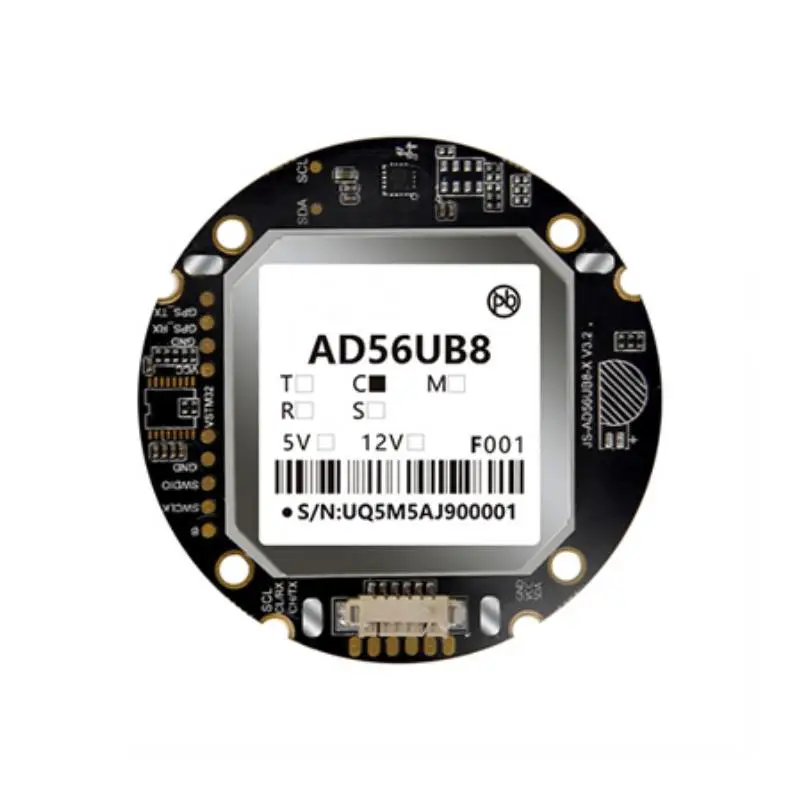
A dual-band L1 plus L5 GPS module is what turns a usable urban-canyon fix into a reliable one. In dense cities, in tree-lined streets, and around tall structures, a single-band GPS module loses lock, drifts, or reports a confidently wrong position. This guide walks through why the L5 band changes the equation, what an L1 plus L5 GPS module actually delivers, and the design choices that determine whether a dual-band GPS module lives up to its billing in the real world.
If you are a hardware engineer, a system architect, or a product manager about to spec a GPS module for an urban, an automotive, or a high-reliability application, the goal of this article is to give you a working framework for deciding whether the L1 plus L5 GPS module is worth the BOM premium. We will not push the technology for its own sake, because a single-band GPS module is still the right answer for many applications. What we will do is walk through the criteria that actually matter when the device has to work in a real city.
What an L1+L5 GPS Module Actually Adds
An L1 plus L5 GPS module tracks two separate GNSS signals from each satellite: the legacy L1 signal at 1575.42 MHz and the modernized L5 signal at 1176.45 MHz. The two signals travel through the ionosphere along slightly different paths, and that path difference is what allows the receiver to compute an ionospheric correction that is good to a few centimeters instead of a few meters. A single-band GPS module cannot make that correction; it has to fall back on a model that is accurate only in mid-latitudes and at night.
In practice, the L1 plus L5 GPS module delivers three concrete advantages over a single-band GPS module: faster time-to-first-fix, higher fix rate under canopy and in urban canyon, and tighter positioning accuracy. The improvement is not subtle. In real-world urban-canyon tests, an L1 plus L5 GPS module typically holds a fix in 30 to 40 percent more epochs than a single-band GPS module, and it does so at sub-2 m accuracy instead of sub-5 m accuracy.
Why Urban Canyons Are So Hard for a Single-Band GPS Module
An urban canyon is a worst-case environment for any GPS module, and the failure modes are well understood. Three effects dominate.
Attenuation. A building wall attenuates the GNSS signal by 10 to 20 dB, and a full canyon can attenuate the direct line-of-sight signal by 30 dB or more. A single-band GPS module at L1 has to integrate longer to dig the signal out of the noise, which costs time-to-first-fix and fix rate. An L1 plus L5 GPS module can use the higher-power L5 signal to lock faster and hold lock through the attenuation.
Multipath. A building face reflects the GNSS signal and creates a secondary path that arrives at the GPS module microseconds after the direct path. The reflected path is longer and the receiver sees the position drift. The L5 signal has a higher chip rate than the L1 signal, which makes it intrinsically more resistant to multipath, and an L1 plus L5 GPS module can use the L5 signal as a multipath-rejecting reference.
Interference. A cellular base station on a nearby rooftop puts out tens of watts of energy in bands that are uncomfortably close to the L1 band. A single-band GPS module at L1 has to tolerate that out-of-band energy, and a poorly filtered L1 front-end can saturate and lose lock. The L5 band is much further from the cellular band, and an L1 plus L5 GPS module can fall back to L5 when the L1 environment is hostile.
Key Specifications of an L1+L5 GPS Module
An L1 plus L5 GPS module lives or dies by a small set of specifications. Reading a generic GPS module datasheet without a framework is a recipe for buying the wrong part.
1. Number of L5-capable constellations. A serious L1 plus L5 GPS module should track L5 from at least GPS, BeiDou, Galileo, and QZSS simultaneously. A part that only tracks L1 plus L5 from a single constellation is leaving the L5 advantage on the table. The number of L5-capable constellations is the single most important differentiator between a serious dual-band GPS module and a marketing-driven one.
2. Channel count and tracking sensitivity. An L1 plus L5 GPS module needs at least 140 channels to track all the visible satellites across both bands. Sensitivity below -165 dBm is the practical floor for urban canyon; parts with -160 dBm sensitivity will struggle in the worst-case urban environment.
3. Time to first fix in urban canyon. A serious L1 plus L5 GPS module delivers a first fix in 5 to 15 seconds in urban canyon. A single-band GPS module typically needs 30 to 60 seconds in the same environment. Always check the urban-canyon time-to-first-fix, not the open-sky number.
4. Power consumption. An L1 plus L5 GPS module at 0.3 to 0.5 W is the practical range for battery-powered products. Above 1 W you start to need active cooling or a larger battery pack. A dual-band GPS module is always going to draw more than a single-band GPS module, but the gap has narrowed significantly in the last two years.
5. L5-specific multipath rejection. An L1 plus L5 GPS module with a dedicated L5 correlator will deliver noticeably better multipath rejection than a part that reuses the L1 correlator. Always ask the vendor for an L5-only fix rate in urban canyon, and compare it against the L1-only number.
How an L1+L5 GPS Module Changes the Trade-Off
An L1 plus L5 GPS module is not a free upgrade. It costs more than a single-band GPS module, draws more power, and needs a wider-band antenna. The trade-off has to be evaluated against the deployment environment. Three application classes dominate the L1 plus L5 GPS module adoption curve.
Urban mobility. Ride-hailing, delivery, scooter, and robotaxi applications all operate in urban canyon. The L1 plus L5 GPS module is the right answer for these products, because the alternative is a position that drifts by tens of meters in exactly the environments the customer cares about. The BOM premium is small relative to the customer-experience improvement.
Automotive. Telematics boxes, eCall systems, and V2X modules all have to deliver a position in urban canyon under regulatory time pressure. The L1 plus L5 GPS module is required for any application that has to meet a sub-2 m or sub-1 m accuracy target, and the L5 signal is increasingly the reference for spoofing-resistant automotive positioning.
Wearable and IoT. Fitness bands, smartwatches, and pet trackers are increasingly spec'd with an L1 plus L5 GPS module to deliver sub-2 m accuracy in the urban environments where the customer actually wears the device. The trade-off is battery life, and the BOM premium is justified only if the customer perceives the accuracy improvement.
Common Pitfalls in L1+L5 GPS Module Integration
Across our L1 plus L5 GPS module deployments, the same four mistakes show up more often than the others. Skim them before you commit to a BOM.
Using a narrow-band L1 antenna. An L1 plus L5 GPS module paired with a narrow-band L1 antenna will receive the L5 signal with significant attenuation, which negates most of the dual-band advantage. Use a wider-band antenna that covers both L1 and L5, or budget for the lost performance.
Underestimating the power budget. An L1 plus L5 GPS module draws noticeably more power than a single-band GPS module, especially when both bands are active. If your product was designed for a single-band GPS module, the L1 plus L5 GPS module will cut battery life by 30 to 50 percent. Plan for it in the power budget before you commit to the part.
Forgetting the L5 antenna matching. The L5 band is at 1176.45 MHz, which is a different frequency from the L1 band. A matching network tuned for L1 may be off-center at L5 and cost 1 to 2 dB of efficiency. Tune the matching network for both bands, or use a wideband matching network that covers both.
Treating the L5 fix as automatic. An L1 plus L5 GPS module will use L5 when it can, but it falls back to L1 when L5 is unavailable. The conditions under which the receiver falls back are vendor-specific, and a serious deployment should validate the fallback behavior in the target environment, not on the bench.
Where We Fit: xyzgnss L1+L5 GPS Module Portfolio
At xyzgnss we have built our L1 plus L5 GPS module portfolio around the same principle that drives the rest of our GNSS product line: tight specifications, documented behavior, and reference designs that move from the bench to a deployed product without a re-engineering step. Our L1 plus L5 GPS module family covers compact modules for IoT and wearable applications, mid-range modules for automotive and industrial use, and high-precision modules for surveying and machine control.
You can browse the GPS module family on the product page, and read our engineering notes on GPS module GNSS IoT integration for a wider view of the deployment trade-offs. For a hands-on reference, our GNSS module with integrated antenna YM-459Q is a representative compact L1 plus L5 part for IoT, and the GPS module robust IoT GNSS field guide covers the integration side of the design.
If you are evaluating an L1 plus L5 GPS module for a new program, our technical team can ship an evaluation kit with the module, a matched L1 plus L5 antenna, and a reference design within two business days. We have supported urban mobility, automotive, and IoT customers across multiple regions, and we are happy to bring that field experience to your project.
Conclusion
An L1 plus L5 GPS module is the right answer for any application that has to work in urban canyon, under tree canopy, or in a hostile RF environment. The BOM premium is small, the power penalty is manageable, and the field improvement is real. If you are weighing an L1 plus L5 GPS module for a new program, our engineering team can help you compare the candidates in your real environment before you commit to a BOM.
Ready to evaluate an L1+L5 GPS module for your urban application? Talk to our engineering team about a side-by-side evaluation, an antenna-matching reference design, and a sample kit. Contact xyzgnss to start a project →
Frequently Asked Questions
Q1: What Is an L1+L5 GPS Module and How Does It Differ From a Single-Band GPS Module?
An L1 plus L5 GPS module tracks two separate GNSS signals from each satellite: the legacy L1 signal at 1575.42 MHz and the modernized L5 signal at 1176.45 MHz. A single-band GPS module tracks only L1. The dual-band GPS module uses the two signals to compute an ionospheric correction that is good to a few centimeters, which delivers faster time-to-first-fix, higher fix rate under canopy, and tighter positioning accuracy.
Q2: Is the L1+L5 GPS Module Worth the BOM Premium for a Consumer Product?
For a consumer product that operates primarily in urban canyon, under tree canopy, or in any environment where the L1 signal is degraded, the L1 plus L5 GPS module is worth the BOM premium. The improvement in fix rate and positioning accuracy is large enough to be perceived by the customer. For a product that operates only in open sky, the single-band GPS module is still the right answer and the BOM savings are real.
Q3: How Much Extra Power Does an L1+L5 GPS Module Draw?
An L1 plus L5 GPS module typically draws 30 to 50 percent more power than a single-band GPS module, especially when both bands are active. A modern L1 plus L5 GPS module at 0.3 to 0.5 W is the practical range for battery-powered products. For wearable and pet-tracker applications, the power penalty is the most important trade-off, and a serious evaluation should measure the actual battery impact in the target use case.
Q4: Can I Use My Existing L1-Only Antenna With an L1+L5 GPS Module?
An L1-only antenna will technically connect to an L1 plus L5 GPS module, but the L5 signal will be attenuated and the dual-band advantage will be lost. Use a wider-band antenna that covers both L1 and L5, or budget for the lost performance. For most OEM products, the antenna upgrade is a small BOM change that delivers a disproportionate improvement in urban-canyon performance.
Q5: Where Can I Get an Evaluation Kit to Test an L1+L5 GPS Module?
We provide evaluation kits for every L1 plus L5 GPS module in our portfolio. A standard kit includes the module on a reference board, a matched L1 plus L5 antenna, a USB interface for raw GNSS output, and a test report covering urban-canyon fix rate, time-to-first-fix, and positioning accuracy. Contact our engineering team and we can typically ship a kit within two business days.