


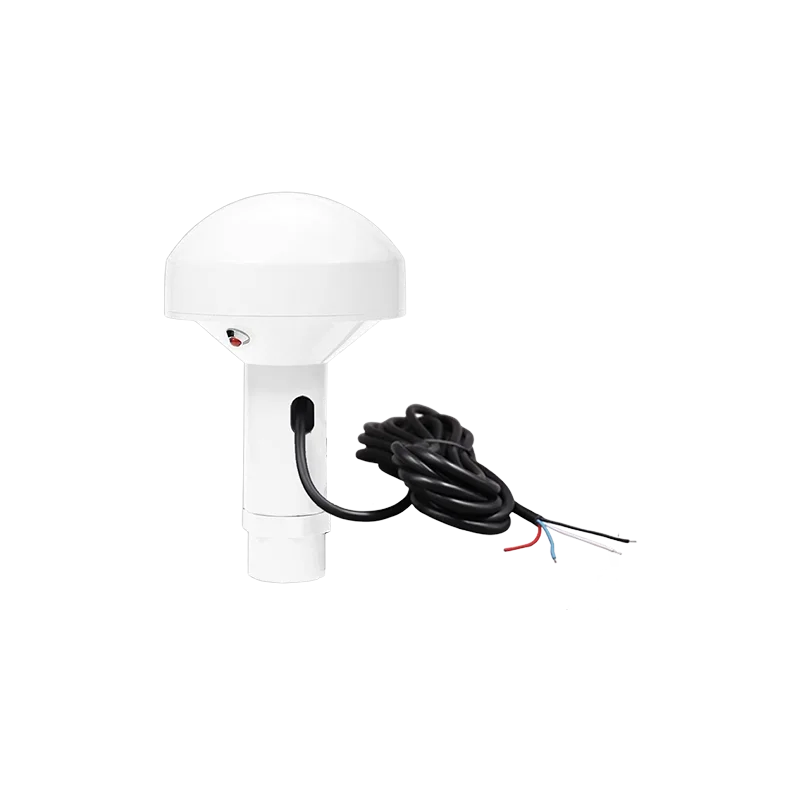
A GPS receiver that delivers clean NMEA sentences is the difference between a system that integrates in an afternoon and one that costs a week of debugging. NMEA 0183 is the lingua franca of GNSS output, and every host system that talks to a GPS receiver has to parse it correctly, validate it, and handle the edge cases that show up in the field. This guide walks through what a GPS receiver actually outputs, how NMEA sentences are structured, and the integration patterns that survive contact with real devices in the real world.
If you are a firmware engineer, a system integrator, or a host-application developer about to wire a GPS receiver into a larger system, the goal of this article is to give you a working framework for parsing NMEA reliably and recovering gracefully when the data is bad. We will not push a specific receiver or a specific parser library, because the right answer depends on the host platform and the application. What we will do is walk through the criteria that actually matter when the GPS receiver is in the field and the data is non-ideal.
What a GPS Receiver Outputs as NMEA
A GPS receiver outputs a stream of ASCII text sentences over a serial port, a USB CDC interface, or a Bluetooth SPP channel. Each sentence starts with a dollar sign, ends with a carriage return and a line feed, and contains a series of comma-separated fields. The first field after the dollar sign is the talker ID and the sentence formatter; the following fields carry the data; the last field before the line terminator is a checksum that the host can use to validate the sentence.
The most common sentences a GPS receiver outputs are GGA (Global Positioning System Fix Data), RMC (Recommended Minimum Navigation Information), GSA (GNSS DOP and Active Satellites), GSV (GNSS Satellites in View), and VTG (Course Over Ground and Ground Speed). A serious host system will subscribe to the sentences it needs and ignore the rest, rather than trying to parse the entire stream and hoping for the best.
Why NMEA Reliability Drives the Whole Integration
A GPS receiver that produces clean NMEA is the foundation of any reliable integration. Three downstream effects dominate.
Time-to-integration. A host system that can rely on the GPS receiver to produce well-formed sentences integrates in hours, not days. A GPS receiver that occasionally drops characters, splits sentences across packets, or delivers malformed checksums forces the host to add retry logic, resync logic, and sanity checks that double the integration cost.
Field reliability. A GPS receiver that has been validated in the lab will see unexpected sentence order, dropped characters, and old timestamps in the field. A host that validates the NMEA stream at the sentence level, the field level, and the timestamp level will keep working when the unexpected happens. A host that trusts the stream blindly will report a confidently wrong position or a stale fix.
Update latency. A GPS receiver that delivers a fix within 100 ms of the satellite measurement allows the host to use the data in a real-time control loop. A GPS receiver that buffers sentences and delivers them in batches adds latency that the host has to absorb. For UAVs, robotics, and machine control, the latency budget is tight and the GPS receiver has to deliver on time.
Anatomy of an NMEA Sentence From a GPS Receiver
An NMEA sentence from a GPS receiver has six logical parts: the start delimiter, the talker ID, the sentence formatter, the data fields, the checksum, and the end delimiter. Each part has rules the host has to respect.
Start delimiter. Every NMEA sentence from a GPS receiver starts with a dollar sign, optionally preceded by a proprietary manufacturer prefix. The host should sync to the start delimiter before it tries to parse, and reject any sentence that does not start with the expected character.
Talker ID and sentence formatter. The two characters after the dollar sign identify the talker (GP for GPS only, GN for multi-constellation, GA for Galileo, BD for BeiDou, GL for GLONASS), and the next three characters identify the sentence type (GGA, RMC, GSA, GSV, VTG). The host should use the talker ID to filter sentences and the sentence formatter to dispatch them to the right parser.
Data fields. The data fields are comma-separated. Empty fields are allowed and mean "not available" rather than "zero". Numeric fields are typically fixed-format with a known number of decimal places, but the host should not assume that a field with a value is valid; many receivers will publish a placeholder value for an invalid field rather than leaving it empty.
Checksum. The checksum is an XOR of all the characters between the dollar sign and the asterisk that precedes the checksum. The host should always validate the checksum before parsing the fields. A GPS receiver that occasionally produces a bad checksum is a sign of a UART buffer overflow, and a serious integration should log the failure rate to detect the underlying problem.
End delimiter. Every NMEA sentence from a GPS receiver ends with a carriage return and a line feed. The host should treat any other line terminator as a protocol violation and reject the sentence.
Field-by-Field Validation in the Host
A serious NMEA parser for a GPS receiver validates every field against its expected format, range, and consistency with the other fields in the sentence. Skipping the validation step is the single most common source of field bugs in GNSS integrations.
Latitude and longitude. A latitude field from a GPS receiver is in the format DDMM.MMMM, with the hemisphere indicator in the following field. A longitude field is in the format DDDMM.MMMM, with the hemisphere indicator in the following field. The host should validate the format, the hemisphere, and the range, and reject any field that does not parse cleanly.
Fix quality. The fix quality field in a GGA sentence indicates whether the GPS receiver is reporting no fix, a GPS fix, a differential GPS fix, or an RTK fix. The host should never trust a position report without first validating the fix quality, and a serious integration should treat no fix and GPS fix differently from RTK fix and PPP fix.
Timestamp. The timestamp field in a GGA or RMC sentence is in the format HHMMSS.SS, UTC. The host should validate the format, the range, and the consistency with the system clock. A GPS receiver that reports a timestamp more than 1 second in the future or 10 seconds in the past is a sign of a problem that the host should not silently accept.
Number of satellites. The number of satellites in use and the number of satellites in view are reported in the GSA and GSV sentences. A serious host should cross-check the two values and flag inconsistencies. A GPS receiver that reports 4 satellites in use but only 3 in view has an internal bug that the host should not paper over.
Common Pitfalls in GPS Receiver NMEA Integration
Across our GPS receiver integrations, the same four mistakes show up more often than the others. Skim them before you commit to a parser design.
Skipping the checksum validation. A host that does not validate the NMEA checksum will eventually accept a corrupted sentence and act on a bad position. Always validate the checksum before parsing, and log the failure rate so you can detect UART buffer problems on the GPS receiver side.
Trusting the fix quality without checking. A GPS receiver that reports an RTK fix in a place where no correction source is available has a bug. Always cross-check the fix quality against the available correction sources before trusting the position, and treat unexpected fix qualities as a red flag.
Blocking the host on the serial read. A host that blocks on the serial port reading NMEA will miss other events. Use a non-blocking read with a ring buffer, and parse the sentences on a worker thread or a timer interrupt. The GPS receiver data is not the only thing the host has to do.
Forgetting the proprietary sentences. Many GPS receivers output proprietary sentences alongside the standard NMEA stream, often for configuration, status, or advanced features. Read the GPS receiver manual and document the proprietary sentences you are using, because they are not part of the NMEA standard and they vary by vendor.
Where We Fit: xyzgnss GPS Receiver Portfolio
At xyzgnss we have built our GPS receiver portfolio around the same principle that drives the rest of our GNSS product line: clean NMEA, documented behavior, and reference parsers that move from the bench to a deployed system without a re-engineering step. Our GPS receiver family includes compact OEM modules, standalone receiver boards, and timing receivers for 5G and substation deployments. Every GPS receiver in the portfolio ships with a documented NMEA manual, a reference parser in C and Python, and example host code for the most common embedded platforms.
You can browse the GPS receiver family on the product page, and read our engineering notes on GPS receiver for reliable fleet tracking for a wider view of the integration trade-offs. For a hands-on reference, the GPS receiver for precision agriculture field guide covers the application side, and our GPS receiver YS-973N is a representative multi-constellation OEM part for demanding integrations.
If you are integrating a GPS receiver into a new host system, our technical team can share a reference parser, a documented NMEA manual, and a sample evaluation kit. We have supported fleet tracking, precision agriculture, and timing customers across multiple regions, and we are happy to bring that field experience to your project.
Conclusion
A clean NMEA stream from a GPS receiver is the foundation of any reliable GNSS integration, and a host parser that validates every field and every checksum is the difference between a system that works in the lab and a system that works in the field. If you are wiring a GPS receiver into a new host, our engineering team can help you choose the right receiver, validate the parser, and ship a reference design that survives contact with real-world data.
Need a GPS receiver with clean NMEA and a reference parser? Talk to our engineering team about a sample kit, a documented NMEA manual, and a reference parser for your platform. Contact xyzgnss to start a project →
Frequently Asked Questions
Q1: What Is NMEA and How Does a GPS Receiver Use It?
NMEA 0183 is the standard ASCII text protocol used by a GPS receiver to deliver position, velocity, time, and satellite data to a host system. Each sentence starts with a dollar sign, contains comma-separated fields, and ends with a checksum and a carriage return/line feed. A GPS receiver outputs a continuous stream of NMEA sentences over a serial port, and the host parses them to extract the data it needs.
Q2: Which NMEA Sentences Should I Subscribe to From a GPS Receiver?
For most host systems, GGA, RMC, and GSA are the minimum set of NMEA sentences to subscribe to from a GPS receiver. GGA delivers the position fix and the fix quality. RMC delivers the position, the velocity, and the date. GSA delivers the DOP and the list of satellites in use. GSV is useful for diagnostics but not for production. VTG is useful for ground speed but can be derived from RMC.
Q3: How Do I Validate an NMEA Sentence From a GPS Receiver?
To validate an NMEA sentence from a GPS receiver, check the start delimiter, the talker ID, the sentence formatter, the data fields, and the checksum. The checksum is the most important validation: it is an XOR of all the characters between the dollar sign and the asterisk that precedes the checksum. If the checksum does not match, reject the sentence and log the failure.
Q4: What Is the Maximum Update Rate of an NMEA Stream From a GPS Receiver?
The maximum update rate of an NMEA stream from a GPS receiver is set by the receiver's measurement rate and the serial port baud rate. A 1 Hz GPS receiver delivers NMEA at 1 Hz. A 10 Hz or 20 Hz receiver delivers NMEA at the corresponding rate, but the sentence length and the baud rate have to support it. At 115200 baud, a 10 Hz GPS receiver can deliver the standard sentence set without any issues.
Q5: Can I Get Binary Output From a GPS Receiver Instead of NMEA?
Yes, most modern GPS receivers support a binary output format alongside the NMEA stream. The binary format is typically a vendor-specific protocol that delivers the raw measurements (pseudorange, carrier phase, Doppler) and the navigation solution at the receiver's full update rate. For high-precision applications, the binary output is essential, because NMEA is limited to the navigation solution and does not expose the raw measurements.