


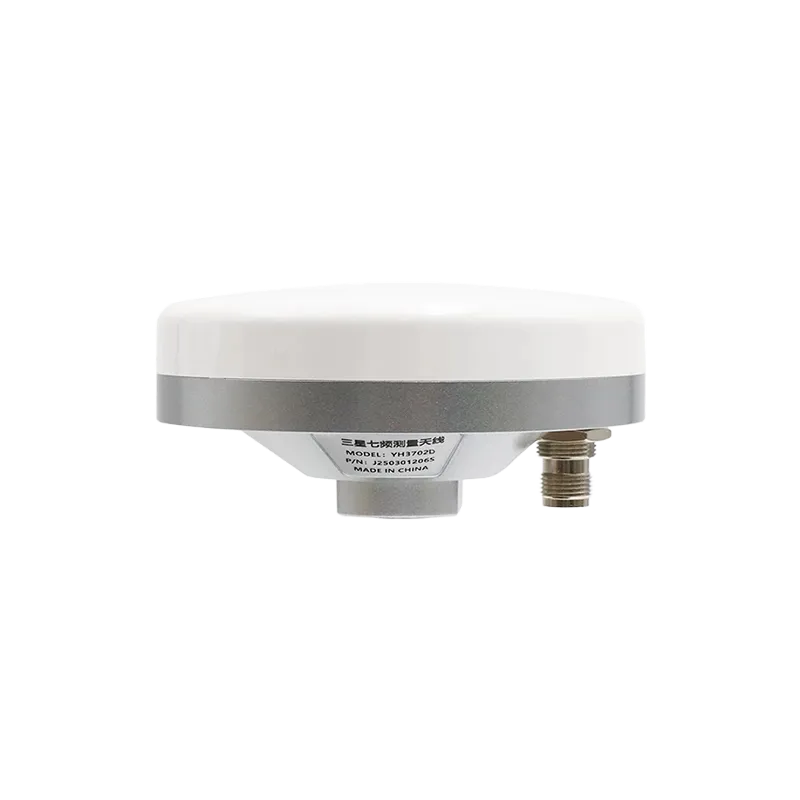
A comprehensive technical breakdown for engineers and integrators to master signal precision and hardware selection.
Introduction to precision navigation documentation
In the rapidly evolving landscape of high-precision positioning, the ability to decipher a technical document is paramount for project success. Whether you are developing autonomous agricultural machinery or geodetic surveying equipment, the RTK GNSS antenna datasheet serves as the blueprint for your system performance. RTK (Real-Time Kinematic) technology relies on centimeter-level accuracy, which is only achievable when the antenna hardware matches the environment and the receiver capabilities. At Yonghao, we understand that an antenna is not merely a passive component but the critical interface between satellite constellations and digital processing units.
This guide will navigate through the complexities of signal frequencies, gain patterns, and environmental protections. By understanding the underlying metrics within an RTK GNSS antenna datasheet, engineers can mitigate multipath interference, reduce time-to-first-fix (TTFF), and ensure long-term reliability in the field. As we explore these parameters, it becomes clear that selecting the right hardware from a trusted provider like Yonghao is the first step toward achieving professional-grade navigation results.
Deciphering frequency support and constellation compatibility
The most vital portion of any RTK GNSS antenna datasheet is the frequency coverage section. Modern high-precision applications no longer rely solely on the GPS L1 frequency. To achieve stable RTK corrections, an antenna must support multiple constellations, including BDS (Beidou), GLONASS, and GALILEO. Multi-band support (such as L1, L2, and L5) allows the receiver to eliminate ionospheric errors, which are the primary source of positioning drift. When reviewing a datasheet, look for full-frequency coverage that ensures compatibility with global satellite networks.
For instance, a high-performance antenna will list specific frequency ranges like 1559-1606 MHz and 1164-1278 MHz. This wide-band capability ensures that even if one signal is obstructed, the system can maintain a fixed solution using alternative frequencies. Yonghao specializes in engineering antennas that provide consistent phase center stability across all these bands, which is a critical metric often found deep within the technical specifications. Without multi-frequency support, the resilience of your RTK system in challenging environments like urban canyons or dense foliage will be significantly compromised.
Phase center offset and variation metrics
A common point of confusion in an RTK GNSS antenna datasheet is the distinction between the mechanical center and the phase center. The Phase Center Offset (PCO) and Phase Center Variation (PCV) are mathematical corrections that define where the signal is actually received. In RTK applications, the goal is to reach millimeter precision. If the phase center shifts as the satellites move across the sky, your positioning data will fluctuate. High-quality datasheets provide sub-millimeter PCV values, indicating that the antenna maintains a stable electrical center regardless of the satellite elevation angle.
When integrating an antenna into a geodetic or industrial system, these values must be accounted for in the software configuration. Yonghao ensures that every antenna undergoes rigorous testing to minimize these variations. A stable phase center is what separates a standard consumer-grade GPS antenna from a professional RTK-capable device. By prioritizing low PCO and PCV values, you ensure that your measurements remain consistent over time, which is essential for long-term monitoring and high-accuracy mapping tasks.
Analyzing LNA gain and noise figure
The Low Noise Amplifier (LNA) built into the antenna plays a decisive role in signal quality. In the RTK GNSS antenna datasheet, you will find metrics for LNA gain (usually expressed in dB) and the Noise Figure. While high gain (e.g., 40 dB) sounds beneficial, it must be balanced with a low noise figure (typically less than 2.0 dB). If the amplifier introduces too much noise, the receiver will struggle to decode the satellite data, leading to a loss of the RTK fix. Yonghao antennas are designed with advanced filtering to suppress out-of-band interference from cellular networks and other electronic equipment.
Another critical aspect is the gain flatness. This refers to how consistently the amplifier performs across the entire frequency range. An antenna with poor gain flatness might perform well on GPS frequencies but fail on GLONASS or BDS. Professional users must ensure that the gain is sufficient to overcome cable losses without saturating the receiver frontend. By carefully selecting a Yonghao antenna with optimized LNA characteristics, you ensure a robust signal-to-noise ratio (SNR) even in electromagnetically noisy environments.
Environmental durability and mechanical design
Beyond the electrical specifications, the RTK GNSS antenna datasheet must be evaluated for mechanical and environmental resilience. For outdoor applications like autonomous tractors or marine navigation, the IP (Ingress Protection) rating is non-negotiable. An IP67 or IP68 rating ensures the antenna is dust-tight and can withstand immersion in water. Furthermore, the operating temperature range should ideally span from -40 to +85 degrees Celsius to handle extreme climates. Yonghao products are built using UV-stabilized materials and high-grade connectors like TNC or SMA to prevent corrosion and physical degradation.
Vibration and shock resistance are also key, especially for antennas mounted on UAVs (Unmanned Aerial Vehicles) or heavy machinery. A datasheet that specifies compliance with MIL-STD-810G standards provides peace of mind that the hardware will not fail during critical operations. The housing design, such as a low-profile dome or a helix structure, also impacts multipath rejection. Yonghao’s engineering team focuses on creating durable form factors that protect the sensitive internal ceramic patches while maintaining a lightweight profile for versatile mounting options.
Professional RTK solutions by Yonghao
As a leader in the satellite navigation industry, Yonghao has dedicated over a decade to developing high-precision GNSS hardware. Our expertise extends from anti-jamming systems to specialized RTK antennas for diverse industrial applications. When you download a RTK GNSS antenna datasheet from our catalog, you are accessing data backed by rigorous lab testing and real-world validation. We pride ourselves on delivering components that meet the highest standards of the EEAT framework: Expertise, Experience, Authoritativeness, and Trustworthiness.
Our product lineup includes the versatile FM206 and the compact U200, both designed for high-precision integration. For UAV developers, we offer modules like the YM-450Q, which combines antenna and receiver technology into a single, efficient package. We also provide industry-leading anti-jamming solutions such as the YH-100 to protect your positioning signals from intentional or accidental interference. Choose Yonghao for reliable, high-performance GNSS solutions tailored to your technical requirements.
Our core advantages
- Full constellation support for GPS, BDS, GLONASS, and GALILEO.
- Advanced multipath mitigation and phase center stability.
- Ruggedized designs for harsh industrial and maritime environments.
- Customization services for unique hardware integration needs.
Featured products
Frequently asked questions
Q1: Why is axial ratio important in an RTK GNSS antenna datasheet?
The axial ratio measures the antenna ability to receive circularly polarized signals while rejecting multipath reflections. A low axial ratio (under 3 dB) listed in the RTK GNSS antenna datasheet ensures that the system can distinguish between direct satellite signals and reflections from buildings or the ground, which is crucial for maintaining centimeter-level accuracy in the RTK solution.
Q2: How do I interpret the gain values in a Yonghao RTK GNSS antenna datasheet?
Gain is typically split into two categories: the passive gain of the antenna element (expressed in dBi) and the active gain of the LNA (expressed in dB). In a Yonghao RTK GNSS antenna datasheet, we provide both to help engineers calculate the total link budget and ensure the signal strength is optimal for the connected receiver module without causing saturation.
Q3: Can a standard antenna be used if the RTK GNSS antenna datasheet doesn't mention L5?
While a single-frequency antenna can provide positioning, RTK performance is vastly improved with L5 frequency support. If an RTK GNSS antenna datasheet does not list L5, the system may take longer to reach a fixed status and will be more susceptible to atmospheric interference. For professional applications, Yonghao recommends multi-band antennas that include the L5 frequency.
Q4: What environmental ratings should I look for in an RTK GNSS antenna datasheet?
For industrial or field use, the RTK GNSS antenna datasheet should specify an IP67 rating for water and dust resistance. Additionally, check for operating temperature limits and vibration testing certifications. Yonghao antennas are designed to perform reliably in environments ranging from humid coastal areas to dry, vibrating agricultural fields.
Q5: How does Yonghao verify the accuracy of its RTK GNSS antenna datasheet?
Every Yonghao RTK GNSS antenna datasheet is the result of intensive testing in anechoic chambers and field trials. We use precision calibrated equipment to measure gain patterns, phase center stability, and noise figures. This ensures that the data provided to our customers is accurate, trustworthy, and reflective of the actual performance in the field.
Optimize your positioning today
Selecting the right hardware is the foundation of precision. Explore our full range of RTK antennas and modules or contact our technical team for a custom solution.