


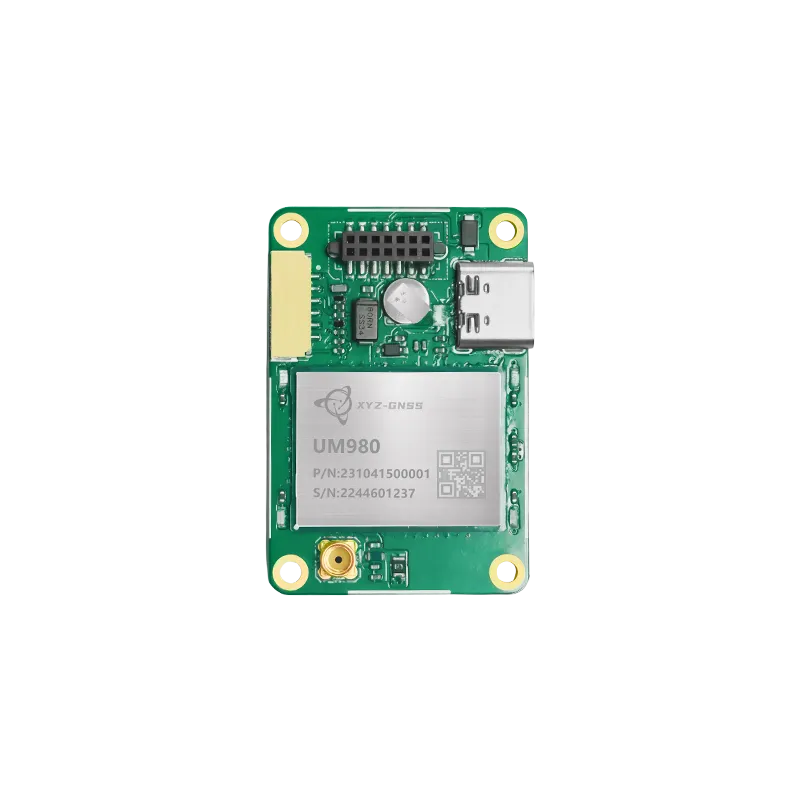
Advancing the boundaries of autonomous navigation through centimeter-level precision and multi-constellation satellite integration.
Introduction to precision in modern robotics
The evolution of autonomous systems has shifted from simple pre-programmed paths to complex spatial awareness requirements. At the heart of this transformation is the need for absolute positioning accuracy. While traditional global navigation satellite systems (GNSS) provide meter-level accuracy, modern applications demand far more precision. Integrating a high-performance RTK GNSS module for robotics is no longer a luxury but a fundamental necessity for developers aiming for reliability. Real-time kinematic (RTK) technology processes the phase of the satellite carrier wave, providing corrections that reduce position errors from meters to mere centimeters. This leap in capability allows robots to navigate narrow corridors, follow precise agricultural rows, or dock at charging stations without human intervention.
In industrial environments, the difference between ten centimeters and two centimeters can mean the success or failure of an entire operation. As robotics move from lab environments to the unpredictable real world, the hardware responsible for positioning must be robust, fast to converge, and capable of maintaining signal lock under challenging conditions. Yonghao has pioneered the development of these modules, ensuring that the latest RTK GNSS module for robotics can handle multi-frequency signals across all major constellations, including GPS, BDS, GLONASS, and Galileo. This multi-system approach ensures that even in urban canyons or near dense foliage, the robot maintains a high-integrity position fix.
The technical architecture of an RTK GNSS module for robotics
Understanding how an RTK GNSS module for robotics functions is critical for effective system integration. The system typically consists of two components: a base station at a known fixed location and a rover module installed on the robotic platform. The base station calculates errors based on its fixed position and transmits correction data to the rover in real time via a radio link or cellular network. The rover then uses this data to eliminate atmospheric delays and satellite clock errors. Modern high-end modules, such as those provided by Yonghao, often integrate the latest chipsets that can process these corrections internally, delivering a direct NMEA output with centimeter-level precision to the robot flight controller or computer.
Beyond the basic correction mechanism, frequency support plays a vital role. A dual-frequency or triple-frequency RTK GNSS module for robotics is significantly more resistant to multipath interference than single-frequency versions. By comparing signals on different bands, such as L1 and L2, the module can faster resolve the integer ambiguity, which is the mathematical hurdle required to reach an RTK fixed state. Furthermore, the inclusion of inertial measurement units (IMU) within the module allows for "dead reckoning" capabilities. This means that if the satellite signal is momentarily lost under a bridge or inside a tunnel, the robot can continue to estimate its position with high accuracy until the signal is reacquired, ensuring continuous and safe operation.
Strategic applications across diverse robotic sectors
The application of an RTK GNSS module for robotics spans across multiple high-growth industries. In precision agriculture, unmanned aerial vehicles (UAV) and ground-based tractors rely on RTK to perform seed planting and pesticide spraying with surgical precision. This level of accuracy prevents overlap in spraying, which saves chemicals and protects the environment. Without RTK, autonomous agricultural equipment would lack the repeatability required to follow the same track through different growing seasons, leading to crop damage and reduced yields. Yonghao solutions provide the stability needed for these machines to operate around the clock, even in remote rural areas with varying signal strengths.
Another booming sector is the autonomous delivery and service robot market. Robotic lawnmowers, for instance, have transitioned from random-path bumping to systematic strip-cutting thanks to the integration of an affordable and compact RTK GNSS module for robotics. In urban delivery scenarios, sidewalk robots must distinguish between a pedestrian path and a vehicle roadway. Centimeter-level accuracy ensures these robots remain within their designated safety zones, minimizing the risk of accidents with traffic or pedestrians. Similarly, in large-scale logistics centers, outdoor-to-indoor transition robots use RTK to navigate between warehouses, ensuring that goods are transported efficiently along the most optimal routes without constant human monitoring or expensive buried-wire infrastructure.
Overcoming integration challenges with Yonghao hardware
Integrating an RTK GNSS module for robotics involves more than just plugging in a chip. Engineers must consider electromagnetic interference (EMI) from motors and electronic speed controllers, which can degrade satellite signal quality. Yonghao addresses these challenges by offering modules with built-in anti-jamming technology and high-quality shielding. When selecting a module, it is also important to consider the communication protocol. Most modern robotics platforms utilize UART, USB, or CAN bus interfaces. Yonghao modules are designed to be "plug-and-play" with popular flight controllers and robotic operating systems (ROS), providing a seamless data stream that integrates directly into the navigation stack.
Size and power consumption are additional hurdles, especially for smaller drones or handheld devices. A high-efficiency RTK GNSS module for robotics must balance processing power with energy usage to avoid draining the robot battery prematurely. Our latest series of modules achieves this by utilizing advanced 12nm or smaller process nodes, reducing heat generation while increasing the update rate to 20Hz or higher. This high update rate is essential for fast-moving robots, as it allows the navigation system to make real-time adjustments to its trajectory, ensuring smooth and responsive movement even at high speeds. By choosing Yonghao, developers gain access to technical support that simplifies the complex calibration processes often associated with high-precision positioning.
Why choose Yonghao for your robotic navigation needs
Yonghao is a leader in the field of high-precision satellite positioning, offering a comprehensive range of products tailored for the next generation of autonomous systems. We specialize in providing the industry with the most reliable RTK GNSS module for robotics, ensuring that our customers can compete in a market where precision is the primary differentiator. Our products are tested in rigorous environments to guarantee performance under extreme temperatures and vibrations, making them ideal for industrial and commercial use. Whether you are building a small-scale research robot or a fleet of autonomous heavy machinery, our modules provide the consistency you need.
Our product lineup includes world-class solutions such as the RTK GNSS module UM982, known for its dual-antenna heading and centimeter-level positioning. For those seeking alternatives to industry standards, our RTK GNSS module UM980 offers full-band tracking as a powerful replacement for the ZED-F9P. We also provide specialized hardware like the RTK GNSS module K902 and the RTK GNSS module mini mosaic G5 for ultra-compact applications. At Yonghao, we don't just sell components; we provide the foundation for autonomous innovation. Explore our full range of RTK GNSS module for robotics products to find the perfect fit for your project.
Frequently asked questions about RTK GNSS modules
Q1: What is the primary benefit of using an RTK GNSS module for robotics?
The primary benefit is centimeter-level positioning accuracy. Unlike standard GPS modules that have an error margin of several meters, an RTK GNSS module for robotics uses real-time corrections to provide accuracy down to 1-2 centimeters, which is essential for autonomous navigation and safety.
Q2: Can a Yonghao RTK GNSS module for robotics work without a local base station?
Yes, our modules can work using NTRIP service providers. This allows the RTK GNSS module for robotics to receive correction data over the internet via a cellular connection, eliminating the need for you to set up and maintain your own physical base station on-site.
Q3: How does an RTK GNSS module for robotics handle signal obstructions?
Yonghao modules feature multi-constellation and multi-frequency support. This means the RTK GNSS module for robotics can track more satellites simultaneously, significantly improving the chances of maintaining a fixed solution even when partially obstructed by buildings or trees.
Q4: Is it difficult to integrate an RTK GNSS module for robotics into existing ROS platforms?
Not at all. Our RTK GNSS module for robotics products are designed to be compatible with industry-standard protocols like NMEA and RTCM. We provide extensive documentation to ensure that integration with ROS or other robotic frameworks is straightforward for developers.
Q5: What makes Yonghao modules different from other RTK GNSS module for robotics options?
Yonghao combines cutting-edge technology with rigorous quality control and exceptional technical support. Our RTK GNSS module for robotics offers superior anti-interference capabilities and faster convergence times, ensuring high reliability for critical autonomous missions.
Empower your autonomous future today
Ready to elevate your robot precision to the next level? Contact Yonghao to find the ideal high-precision solution for your needs.