


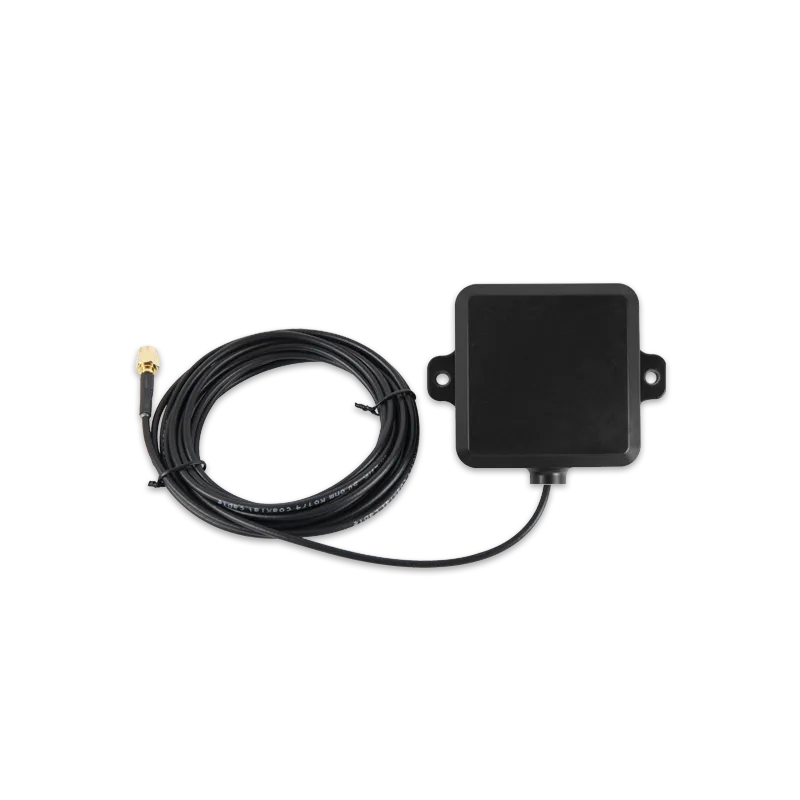
A comprehensive technical guide to achieving centimeter-level precision in modern autonomous navigation systems.
The revolution of autonomous driving relies heavily on the ability of a vehicle to perceive its position with absolute certainty. While standard satellite navigation provides a general idea of location, it lacks the precision necessary for safe lane-keeping and complex maneuvers. This is where the RTK GNSS antenna for autonomous vehicles becomes an indispensable component. By utilizing real-time kinematic (RTK) technology, these antennas allow vehicles to correct atmospheric errors and satellite clock drifts, reducing positioning error from several meters to just a few centimeters. The integration of such high-precision hardware is not merely an upgrade; it is a fundamental requirement for any platform aiming for Level 3 autonomy or higher. As the industry moves toward mass-market adoption, understanding the technical nuances of these antennas—from their phase center stability to their ability to mitigate multi-path interference—is critical for engineers and system integrators alike.
Critical accuracy requirements for centimeter-level positioning
To achieve the performance required for self-driving platforms, an RTK GNSS antenna for autonomous vehicles must meet rigorous technical standards. The most vital of these is phase center stability. A stable phase center ensures that the point where the satellite signal is received does not shift significantly relative to the physical center of the antenna, regardless of the angle of the incoming signal. Without this stability, the RTK algorithms cannot maintain the fixed integer ambiguity necessary for centimeter-level results. Furthermore, the antenna must support multi-frequency and multi-constellation signals, including GPS, BDS, GLONASS, and Galileo. Accessing multiple frequencies (such as L1, L2, and L5) allows the system to converge faster and maintain a reliable position even when some satellites are obstructed.
Beyond signal reception, the gain and axial ratio of the antenna are paramount. High gain at low elevation angles ensures that the vehicle can track satellites near the horizon, which is essential when driving through narrow streets or hilly terrain. A low axial ratio across the entire bandwidth indicates superior circular polarization, which helps the antenna distinguish between direct satellite signals and reflected ones. For high-speed autonomous vehicles, the update rate and latency of the combined antenna-module system must also be minimized to ensure that the positioning data reflects the vehicle's current state in real-time. These factors combined define the reliability of the spatial awareness that governs every decision made by the onboard flight or drive computer.
Advanced anti-interference and signal protection features
The urban environment is a hostile territory for satellite signals. Multi-path interference, where signals bounce off buildings and pavement before reaching the receiver, is the primary enemy of precision. A professional RTK GNSS antenna for autonomous vehicles incorporates sophisticated multi-path mitigation techniques, such as specialized ground planes or choke ring designs, to suppress reflected signals from below or the side. Additionally, modern antennas are equipped with robust LNA (low noise amplifier) modules that feature multi-stage filtering. This is crucial because autonomous vehicles are packed with other electronic components—radars, Lidars, and cellular modems—that can generate electromagnetic interference (EMI). High-performance filtering prevents these local signals from saturating the GNSS receiver, maintaining a clear path for weak satellite data.
Moreover, the threat of intentional or unintentional jamming cannot be overlooked. Advanced antennas often work in tandem with anti-jamming terminals to provide a layer of defense against signal spoofing. For instance, four-channel or eight-channel anti-interference systems can identify the direction of a jamming source and "null" it out, allowing the vehicle to continue operating safely. In the context of autonomous fleets, this resilience is a safety-critical feature. An antenna that can maintain a lock in the presence of noise not only improves the availability of the RTK fix but also enhances the overall trust in the autonomous system. Protecting the integrity of the GNSS signal ensures that the vehicle does not experience "positioning jumps," which could lead to erratic steering or emergency braking.
Strategies for seamless system integration on vehicle platforms
Integrating an RTK GNSS antenna for autonomous vehicles requires more than just mounting it on the roof. Engineers must consider the physical placement to ensure a 360-degree clear view of the sky, away from large metal obstructions that might cause signal shadowing. The choice of RF (radio frequency) cables is also critical; high-quality, low-loss cables are necessary to preserve signal strength over the distance between the roof-mounted antenna and the internally housed GNSS module. Furthermore, the antenna must be ruggedized to withstand the harsh conditions of automotive use, including constant vibrations, thermal cycling from -40 to +85 degrees Celsius, and exposure to rain or dust. IP67 or IP69K ratings are standard for antennas used in this sector to ensure long-term durability.
On the software side, the antenna must be perfectly paired with a high-performance positioning module. Integration involves configuring NMEA or proprietary binary protocols to transmit high-speed positioning data to the vehicle's main processing unit. Many developers choose modules that support integrated IMU (inertial measurement unit) data, allowing for dead reckoning during brief GNSS outages, such as when driving through tunnels. The synergy between the antenna's raw signal capture and the module's algorithmic processing determines the ultimate performance. By following standardized mounting protocols and utilizing high-quality connectors like FAKRA or SMA, manufacturers can ensure that the high-precision GNSS subsystem remains the most reliable sensor in the vehicle's perception stack.
The Yonghao advantage in high-precision navigation
At Yonghao, we specialize in providing cutting-edge satellite navigation solutions tailored for the most demanding applications. Our expertise spans from high-gain antennas to sophisticated anti-jamming systems, ensuring that your autonomous platforms remain connected and accurate in any environment. Our range of RTK GNSS antenna for autonomous vehicles products, such as the FM206 and the YH-100, are designed with phase center stability and multi-constellation support at their core.
We understand that the success of autonomous driving depends on the reliability of the hardware. That is why our products undergo rigorous testing to meet automotive standards. For clients seeking a complete solution, we offer integrated modules like the ZED-F9P and UM980, which pair perfectly with our antennas to deliver instant centimeter-level positioning. Whether you are developing robotic lawnmowers, UAVs, or full-scale self-driving cars, Yonghao provides the technical support and product customization needed to bring your vision to life.
Conclusion
The path toward fully autonomous transportation is paved with high-precision data. The RTK GNSS antenna for autonomous vehicles serves as the primary gateway for this data, transforming satellite signals into actionable spatial intelligence. By prioritizing accuracy, investing in anti-interference technology, and ensuring robust system integration, manufacturers can build platforms that are not only smarter but significantly safer. As the GNSS landscape continues to evolve with more satellites and new signal frequencies, staying equipped with the latest antenna technology will be the key to maintaining a competitive edge in the autonomous industry.
Frequently asked questions
Q1: Why is an RTK GNSS antenna for autonomous vehicles necessary for lane-level navigation?
Standard GNSS has a typical error margin of 2-5 meters, which is wider than most traffic lanes. An RTK GNSS antenna for autonomous vehicles provides the centimeter-level accuracy needed to ensure the vehicle stays precisely within its designated lane, especially in complex highway interchanges.
Q2: How does an RTK GNSS antenna for autonomous vehicles handle signals in urban canyons?
In urban environments, signals reflect off tall buildings. Yonghao antennas utilize advanced multi-path rejection designs and high-gain elements to filter out these reflections, allowing the RTK GNSS antenna for autonomous vehicles to maintain a stable fix even when the sky view is partially obstructed.
Q3: Can a Yonghao RTK GNSS antenna for autonomous vehicles work with any GNSS module?
Yes, our antennas are designed with universal connectors and standard voltage requirements, making them compatible with industry-leading modules like the ZED-F9P, UM980, and others used in the development of an RTK GNSS antenna for autonomous vehicles system.
Q4: What environmental protection does a typical RTK GNSS antenna for autonomous vehicles require?
Since they are mounted externally, these antennas require IP67 or higher waterproofing. Yonghao ensures that every RTK GNSS antenna for autonomous vehicles is built to withstand extreme temperatures and constant vibration, ensuring longevity on the road.
Q5: How does multi-frequency support improve the performance of an RTK GNSS antenna for autonomous vehicles?
Multi-frequency support (L1, L2, L5) allows for faster convergence times and better atmospheric error correction. By receiving more data points, the RTK GNSS antenna for autonomous vehicles can achieve a "fixed" solution much faster than single-frequency models.
Ready to elevate your autonomous system precision?
Contact our technical team today for customized GNSS solutions and expert integration advice.
Get in touch now