


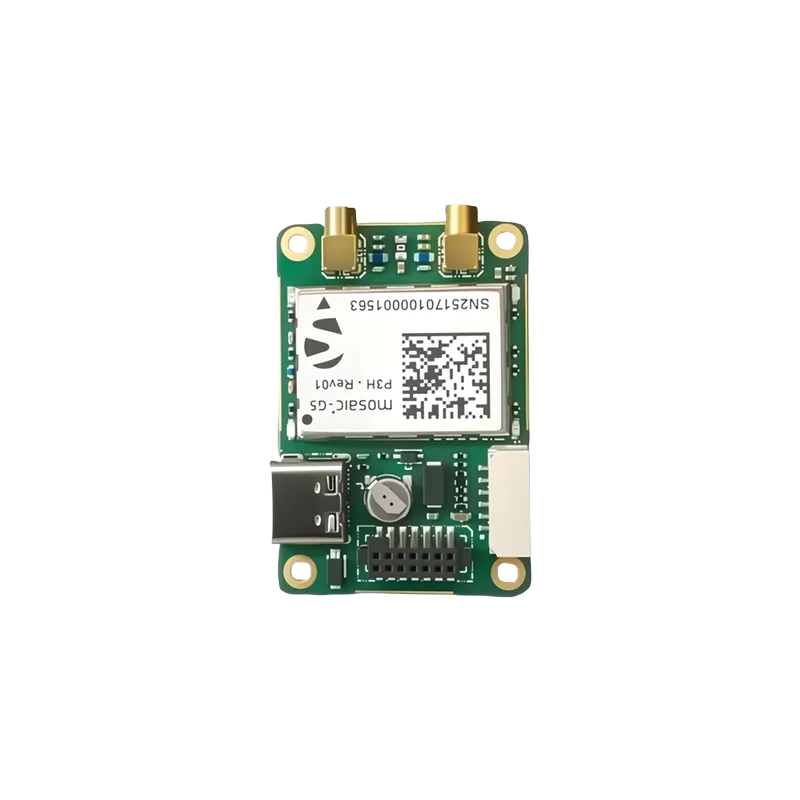
The landscape of modern transportation is undergoing a radical shift toward full automation. At the heart of this revolution lies the need for absolute spatial awareness. Traditional global positioning systems, while adequate for general smartphone navigation, fall short when a vehicle needs to distinguish between two lanes separated by only a few meters. This is where the RTK GNSS module for autonomous vehicles becomes an indispensable component of the hardware stack.
Real-time kinematic (RTK) technology enhances satellite positioning by using a carrier phase measurement to provide centimeter-level accuracy. For self-driving cars, this level of precision is not just a luxury; it is a fundamental safety requirement. By integrating an advanced RTK GNSS module for autonomous vehicles, engineers can ensure that the vehicle maintains a reliable trajectory, even when operating in complex environments where traditional signals might degrade.
Understanding the mechanics of high-precision positioning
To understand why an RTK GNSS module for autonomous vehicles is superior, one must look at how it handles atmospheric errors. Standard GNSS signals pass through the ionosphere and troposphere, which causes delays and inaccuracies. RTK overcomes this by utilizing a base station and a rover (the vehicle). The base station provides real-time corrections to the rover, canceling out common errors and allowing the onboard processor to resolve the carrier phase of the satellite signal.
Modern modules now support multi-constellation and multi-frequency tracking. This means they can simultaneously receive signals from GPS, BDS, GLONASS, and GALILEO. By utilizing multiple bands such as L1, L2, and L5, the module can faster resolve the initial integer ambiguity, leading to a "fixed" solution in seconds rather than minutes. This rapid convergence is critical for autonomous platforms that need to start and move safely without long calibration periods.
Furthermore, the physical integration of these modules has evolved. Automotive-grade hardware must withstand extreme temperatures, vibrations, and electromagnetic interference. Leading manufacturers focus on reducing the footprint of these modules while increasing their computational power, allowing them to handle complex algorithms locally rather than relying on external processing units.
Sensor fusion and the role of dead reckoning
Positioning data from satellites is only one piece of the puzzle. In the automotive industry, vehicles often encounter "urban canyons," tunnels, and multi-level parking structures where satellite signals are blocked or reflected. An effective RTK GNSS module for autonomous vehicles is usually paired with an inertial measurement unit (IMU) through a process called sensor fusion. This combination enables GNSS/INS integrated navigation.
When the satellite signal is lost, the IMU provides data on the vehicle’s acceleration and angular velocity. The onboard Kalman filter uses the last known high-precision RTK position and integrates it with the IMU data to estimate the current position. This "dead reckoning" capability ensures that the autonomous system never loses its sense of location, maintaining a smooth and safe path until the GNSS signal is reacquired.
Beyond the IMU, the module also interacts with vehicle odometry and steering sensors. This multi-layered approach to data ensures that even if one sensor fails or provides noisy data, the system has redundant information to verify its spatial coordinates. This redundancy is the cornerstone of functional safety in Level 4 and Level 5 autonomous driving systems, where human intervention is minimal or non-existent.
Strategic considerations for automotive integration
When selecting a positioning solution, hardware engineers must evaluate several key metrics: time to first fix (TTFF), update rate (Hz), and power consumption. For high-speed autonomous driving, an update rate of 10Hz or 20Hz is often required to provide the steering computer with timely information. A slow update rate could lead to "latency errors," where the vehicle's actual position is ahead of the reported position.
Another factor is the antenna design. High-gain, multi-frequency antennas are necessary to capture weak signals. For automotive applications, low-profile shark-fin or integrated patch antennas are preferred for their aerodynamic properties and durability. The synergy between the module and the antenna is vital; a high-end RTK GNSS module for autonomous vehicles will only perform as well as the signal it receives from its antenna.
Cost-efficiency is also becoming a major driver as autonomous features move from luxury vehicles to mass-market models. Modern silicon manufacturing has allowed the production of high-precision RTK modules at a fraction of the cost of geodetic-grade equipment used a decade ago. This democratization of centimeter-level accuracy is what allows for the widespread deployment of robotic taxis, autonomous delivery pods, and smart agricultural machinery.
Why choose Yonghao for your navigation needs
Yonghao has established itself as a leader in the precision positioning industry by delivering robust, automotive-grade solutions. Our expertise spans over a decade of research and development in GNSS technology, ensuring that our products meet the rigorous demands of modern autonomous systems. We provide a comprehensive range of hardware designed to withstand the harsh environments of the road while delivering unmatched accuracy.
Our flagship RTK GNSS module for autonomous vehicles, the UM982, offers dual-antenna heading and centimeter-level positioning in a single compact footprint. For those seeking versatile integration, our ZED-F9P compatible modules provide multi-band support and high reliability for robotic lawnmowers, UAVs, and self-driving vehicles.
Beyond modules, Yonghao offers integrated solutions like the YHRTK-980, which supports all constellations including BDS, GPS, and GALILEO. Our products are engineered for seamless integration, featuring standard interfaces and extensive technical support. Whether you are developing a prototype or scaling to mass production, our team at Yonghao is dedicated to your success.
Our competitive advantages
- High-precision multi-band RTK technology for centimeter accuracy.
- Rugged automotive-grade designs resistant to interference.
- Comprehensive sensor fusion algorithms for GNSS/INS integration.
- Global constellation support including BDS, GPS, and GLONASS.
Frequently asked questions
Q1: How does an RTK GNSS module for autonomous vehicles handle lane-level navigation?
By utilizing real-time kinematic corrections, the module can achieve centimeter-level accuracy. This allows the vehicle's control system to distinguish precisely which lane it is in, even on complex multi-lane highways or at interchanges, providing a level of safety that standard GPS cannot match.
Q2: Can an RTK GNSS module for autonomous vehicles work without a local base station?
Yes, many modern systems utilize NTRIP (Networked Transport of RTCM via Internet Protocol). This allows the vehicle to receive correction data from a network of base stations via a cellular connection, eliminating the need for the vehicle owner to maintain their own physical base station.
Q3: What happens to the RTK GNSS module for autonomous vehicles when driving through a long tunnel?
In tunnels, satellite signals are lost. However, Yonghao modules integrated with IMU sensors use dead reckoning to calculate the vehicle's position based on its speed, heading, and acceleration until it exits the tunnel and re-establishes a satellite fix.
Q4: Is the RTK GNSS module for autonomous vehicles resistant to signal jamming or spoofing?
Yonghao offers advanced anti-jamming terminals and modules that use multi-frequency filtering and multi-constellation checks to detect and mitigate interference, ensuring the integrity of the positioning data even in contested environments.
Q5: How easy is it to integrate a Yonghao RTK GNSS module for autonomous vehicles into existing platforms?
Our modules are designed with standard communication protocols such as NMEA and RTCM. They feature easy-to-use interfaces and are compatible with popular flight controllers and automotive computers, making the integration process straightforward for engineering teams.
Conclusion
The path to reliable and safe autonomous driving is paved with high-precision data. The RTK GNSS module for autonomous vehicles stands as a critical pillar in this ecosystem, providing the centimeter-level accuracy required for lane-level positioning and complex maneuvering. By combining satellite data with inertial sensors and robust hardware design, companies can overcome the challenges of urban environments and unpredictable signal conditions.
At Yonghao, we are committed to pushing the boundaries of what is possible in navigation technology. Our range of modules and antennas offers the reliability and performance necessary for the next generation of autonomous vehicles.