


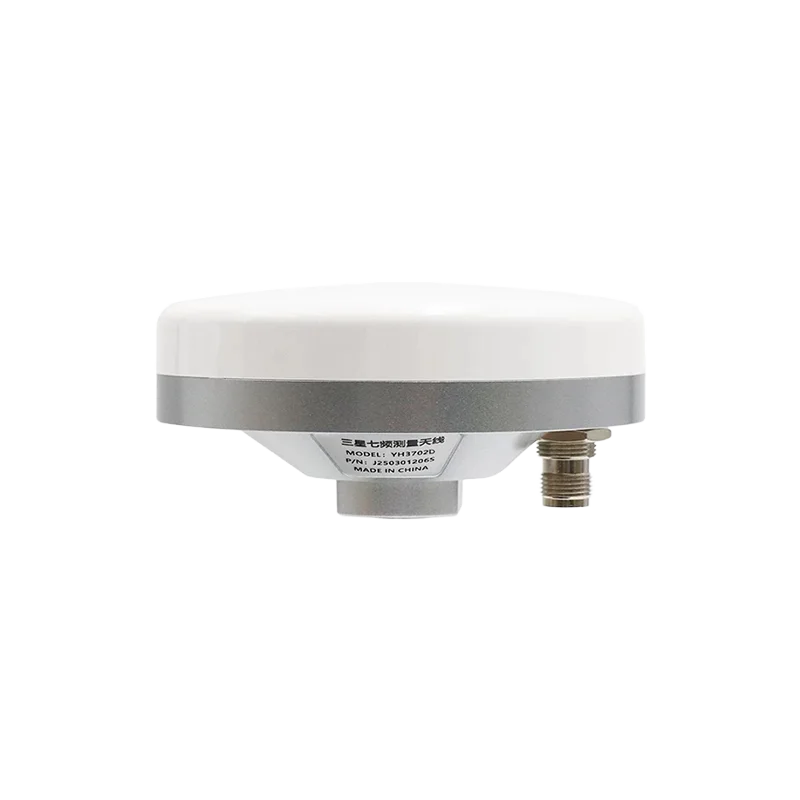
A choke ring antenna is the gold standard for geodetic and control-survey applications because no other antenna topology matches its ability to reject low-elevation multipath. While a high-quality patch antenna can deliver 95 percent of the performance of a choke ring antenna in a controlled environment, the choke ring wins in the field, where the multipath from the ground, the tripod, and the surrounding structures sets the floor on the achievable accuracy. This guide walks through what a choke ring antenna actually does, why it still dominates geodetic surveying, and the design choices that determine whether a choke ring antenna is worth the size, the weight, and the BOM premium in your application.
If you are a geodesist, a survey engineer, or a system integrator about to spec a choke ring antenna for a precision application, the goal of this article is to give you a working framework for understanding the choke ring design, evaluating the trade-offs against a high-quality patch, and matching the part to the accuracy target of your project. We will not push a single antenna topology, because the right answer depends on the application. What we will do is walk through the criteria that actually matter when the survey point has to be re-occupied a year from now and reproduce the same coordinate.
What a Choke Ring Antenna Actually Does
A choke ring antenna uses a series of concentric rings cut into a metal ground plane around the central radiating element. The rings are sized to a quarter wavelength at the GNSS L-band center frequency, and they form quarter-wave choke cavities that present a high impedance to any signal arriving from below the horizon. The result is that the choke ring antenna rejects low-elevation multipath by 15 to 25 dB relative to a high-quality patch, and the rejection extends all the way down to the horizon.
In practice, the choke ring antenna delivers two concrete advantages over a patch. First, the multipath rejection is significantly higher at low elevation, which is exactly where the GNSS satellites spend a meaningful fraction of their time and where the multipath from the ground, the tripod, and the surrounding structures is strongest. Second, the phase center of a choke ring antenna is more stable across the upper hemisphere, which directly translates to sub-millimeter phase center repeatability for control-survey applications.
Why the Choke Ring Antenna Still Dominates Geodetic Surveying
A choke ring antenna is not just a more expensive version of a patch. It is a fundamentally different system, and the difference shows up in three operational effects that matter for geodetic and control-survey work.
Low-elevation multipath rejection. The choke ring antenna rejects low-elevation multipath that a patch antenna cannot. For a control survey, the low-elevation multipath sets the floor on the achievable accuracy, and the choke ring is the only practical way to push that floor down. A high-quality patch may deliver 5 mm accuracy in a controlled environment, but in the field the same patch may be limited to 10 mm by low-elevation multipath, while a choke ring still delivers 5 mm.
Phase center stability. The choke ring antenna delivers a more stable phase center than a patch, because the choke rings smooth out the phase center variation that comes from the multipath. For a control survey, phase center stability is what determines whether two occupations of the same point agree to within the noise floor or disagree by 5 to 10 mm.
Published absolute calibration. A serious choke ring antenna ships with a published absolute calibration model that is transferable across instruments of the same model. A patch antenna may have only a relative calibration, or no calibration at all. For a geodetic network, the absolute calibration is what allows the network to be tied to a global reference frame.
Key Specifications of a Choke Ring Antenna
A choke ring antenna lives or dies by a small set of specifications. Reading a generic GNSS antenna datasheet without a framework is a recipe for buying the wrong part.
1. Number of rings and ring depth. A serious choke ring antenna has at least 3 to 5 rings, with the ring depth tuned to a quarter wavelength at the L1 center frequency. A choke ring antenna with only 2 rings will deliver some low-elevation multipath rejection, but not enough for control-survey work. A choke ring antenna with 5 or more rings is the gold standard for geodetic and reference-station deployments.
2. Phase center variation across the upper hemisphere. A serious choke ring antenna has a phase center variation below 2 mm across the upper hemisphere, and below 1 mm above 30 degrees elevation. A patch antenna typically has 2 to 5 mm variation. The choke ring is the right answer for any application that has to be re-measured across days or seasons.
3. Multipath rejection at low elevation. A serious choke ring antenna delivers 15 to 25 dB of multipath rejection at 5 to 10 degrees elevation, relative to a high-quality patch. The exact number depends on the ring design, the dielectric loading, and the radome. Always ask for the multipath rejection curve, not just a single number.
4. L1, L2, and L5 support. A modern choke ring antenna supports L1, L2, and L5 simultaneously, with the choke rings tuned to deliver multipath rejection across all three bands. A single-band choke ring antenna is fine for legacy applications but is being phased out as multi-frequency receivers become the norm.
5. Published absolute calibration model. A serious choke ring antenna vendor publishes an absolute calibration model for the antenna, generated in an anechoic chamber or a robot-based calibration facility. Without a published model, the choke ring antenna can only be used in differential mode, and the user cannot take advantage of absolute positioning services.
When a Choke Ring Antenna Is and Is Not the Right Answer
A choke ring antenna is the right answer for some applications and the wrong answer for others. The right answer depends on the accuracy target, the deployment environment, and the operational tempo of the program.
Geodetic and control surveys. A choke ring antenna is the right answer for any geodetic or control-survey application, because the low-elevation multipath rejection and the phase center stability are non-negotiable. A high-quality patch may deliver comparable accuracy in a controlled environment, but in the field the choke ring is the only practical way to push the floor down to the millimeter level.
Reference stations. A choke ring antenna is the right answer for any reference station that has to deliver centimeter- or millimeter-level corrections to a network of rovers. The published absolute calibration model is what allows the reference station to be tied to a global reference frame, and the multipath rejection is what ensures the corrections are clean.
Mapping and GIS. A choke ring antenna is usually overkill for mapping and GIS applications, where a high-quality patch is sufficient. The BOM premium of a choke ring is hard to justify for sub-decimeter mapping accuracy, and the size and weight make the choke ring awkward for handheld rovers.
UAV and lightweight rovers. A choke ring antenna is usually the wrong answer for UAV and lightweight rover applications, because the size and weight are incompatible with the platform. A high-quality patch is the right answer for these applications, and the BOM savings can be invested in a better receiver or a wider-band antenna.
Common Pitfalls in Choke Ring Antenna Selection
Across our choke ring antenna deployments, the same four mistakes show up more often than the others. Skim them before you commit to a part.
Mounting the choke ring antenna next to a metallic object. A metallic object within 30 cm of the choke ring antenna can shift the phase center by several millimeters and degrade the multipath rejection. The choke ring antenna has to be mounted with at least 30 cm of clearance from any metallic structure, including the tripod and the range pole.
Forgetting the radome. A choke ring antenna without a radome will collect water, snow, and debris in the choke cavities, which destroys the multipath rejection. Always use a radome, and inspect it regularly for damage or water ingress.
Using a choke ring antenna without calibration. A choke ring antenna without a published absolute calibration model is only useful in differential mode. For absolute positioning, the calibration model is essential, and a serious vendor will publish it for every part.
Skipping the field validation. A chamber calibration is necessary but not sufficient. The choke ring antenna has to be validated in the field against a known control point before it is accepted into a production survey crew. A field validation that disagrees with the chamber calibration is a sign of a real-world problem that has to be resolved before deployment.
Where We Fit: xyzgnss Choke Ring Antenna Portfolio
At xyzgnss we have built our choke ring antenna portfolio around the same principle that drives the rest of our GNSS product line: tight multipath rejection specifications, documented absolute calibrations, and reference designs that move from the bench to a control point without a re-engineering step. Our choke ring antenna family includes 3-ring, 5-ring, and 7-ring variants for geodetic, reference-station, and high-precision control-survey deployments.
You can browse the choke ring antenna family on the product page, and read our engineering notes on choke ring antenna geodetic monitoring for a wider view of the deployment trade-offs. For a hands-on reference, our RTK GNSS antenna base station deployment field guide covers the fixed-site installation, and the wider all-antenna product page lists our complete portfolio.
If you are evaluating a choke ring antenna for a precision program, our technical team can share an absolute calibration report, a field validation dataset, and a sample antenna for testing. We have supported geodetic, control-survey, and reference-station customers across multiple regions, and we are happy to bring that field experience to your project.
Conclusion
A choke ring antenna is the gold standard for geodetic and control-survey applications, and the low-elevation multipath rejection, the phase center stability, and the published absolute calibration are the three reasons why it has remained the dominant design for decades. A high-quality patch can deliver 95 percent of the performance of a choke ring in a controlled environment, but the choke ring wins in the field, where the multipath sets the floor. If you are weighing a choke ring antenna for a precision program, our engineering team can help you compare the candidates in your real environment before you commit to a part.
Need a choke ring antenna with documented multipath rejection? Talk to our engineering team about an absolute calibration report, a field validation dataset, and a sample antenna. Contact xyzgnss to start a project →
Frequently Asked Questions
Q1: What Is a Choke Ring Antenna and Why Is It Used for Geodetic Surveying?
A choke ring antenna is a GNSS antenna with a series of concentric rings cut into the ground plane around the central radiating element. The rings form quarter-wave choke cavities that reject low-elevation multipath by 15 to 25 dB relative to a high-quality patch. The choke ring antenna is the gold standard for geodetic and control-survey applications because no other topology matches its low-elevation multipath rejection and phase center stability.
Q2: How Many Rings Does a Choke Ring Antenna Need for Geodetic Work?
A serious choke ring antenna for geodetic work has at least 3 to 5 rings, with the ring depth tuned to a quarter wavelength at the L1 center frequency. A 3-ring choke ring antenna is a good entry point for control-survey work. A 5-ring or 7-ring choke ring antenna is the gold standard for geodetic and reference-station deployments where the low-elevation multipath rejection has to be maximized.
Q3: Is a Choke Ring Antenna Always Better Than a High-Quality Patch?
A choke ring antenna is not always better than a high-quality patch, because the right answer depends on the application. For geodetic and control-survey work, the choke ring is the clear winner because the low-elevation multipath rejection and the phase center stability are non-negotiable. For mapping and GIS, a high-quality patch is usually sufficient and the BOM premium of a choke ring is hard to justify. For UAV and lightweight rover applications, a choke ring is usually the wrong answer because of the size and weight.
Q4: Does a Choke Ring Antenna Need a Radome?
A choke ring antenna needs a radome to keep water, snow, and debris out of the choke cavities. Without a radome, the choke ring antenna will collect moisture and the multipath rejection will degrade significantly. A serious choke ring antenna vendor ships the antenna with a radome, and the radome has to be inspected regularly for damage or water ingress. A damaged radome can drop the multipath rejection by 5 to 10 dB, which defeats the purpose of the choke ring design.
Q5: Where Can I Get a Choke Ring Antenna With a Published Absolute Calibration Model?
We supply choke ring antennas with published absolute calibration models for geodetic, control-survey, and reference-station deployments. Each antenna ships with a calibration report generated in our robot-based facility, plus a field validation dataset. Contact our engineering team and we can share the calibration report for the choke ring antenna you are evaluating, along with a sample antenna for testing in your real environment.